The 2019 session that was, and the one yet to come

Alabama legislators ended their 2019 regular session last week. But they’re not done yet.

Amid the threat of federal intervention, the Legislature likely will hold a special session this fall to address horrendous conditions in our state’s overcrowded prisons. This summer, Arise will continue making the case that meaningful prison reform must include Medicaid expansion. This move would cut state health care costs and help former inmates stay healthy and productive after release. And it would help people stay out of prison by strengthening treatment for mental illness and substance use disorders.

Arise will renew our call to fund these needed investments by fixing Alabama’s upside-down tax system. With high sales taxes and big tax breaks for rich people, this broken system is the worst of both worlds. It pushes struggling families deeper into poverty, and it doesn’t bring in enough money to provide adequate funding for corrections and other vital services. Untaxing groceries and ending the state’s deduction for federal income taxes would be two huge steps to undo that damage.

Breakthroughs on civil asset forfeiture, voting rights

Arise members’ advocacy led to progress on civil asset forfeiture and voting rights this year. Lawmakers voted unanimously for SB 191, sponsored by Sen. Arthur Orr, R-Decatur, which will increase transparency around forfeitures in Alabama. And they approved SB 301, sponsored by Sen. Rodger Smitherman, D-Birmingham, which will expand access to absentee ballots.

Our supporters were key in stopping numerous proposals to erect harmful new barriers to Medicaid and food assistance under the Supplemental Nutrition Assistance Program (SNAP). We also saw major breakthroughs on several recent Arise issue priorities and endorsements:

  • HB 225, sponsored by Rep. Adline Clarke, D-Mobile, will forbid pay discrimination based on race or sex.
  • SB 30, sponsored by Sen. Cam Ward, R-Alabaster, will ensure that inability to pay filing fees won’t block low-income Alabamians from pursuing their rights in court.
  • SB 228, sponsored by Orr, will increase jail food funding and prevent sheriffs from pocketing any leftover money.

Two other topics dominated the headlines at the State House this year. Legislators moved quickly to pass an abortion ban that is certain to face a lengthy, expensive court challenge. They also hustled to pass a 10-cent gas tax increase for infrastructure improvements during a special session in March.

The work that remains undone

But lawmakers showed much less urgency when it came to investments in human services. While Alabama’s funding for K-12 and higher education is increasing, it’s still well below 2008 levels. Similarly, General Fund (GF) revenues are rising. But it’s not nearly enough to reverse decades of underinvestment in Medicaid, mental health care, child care and other services.

The Legislature also waited until the session’s final week before finally deciding the GF, rather than the education budget, would pay for the state’s share of the Children’s Health Insurance Program. CHIP supports coverage for more than 170,000 Alabama kids.

Some climbs remain steeper than others. Reforms of payday lending and the death penalty struggled to gain traction this year. So did proposals for automatic voter registration and early voting. But Arise members – unafraid and undeterred – will keep working for those changes and others to promote opportunity, prosperity and justice for all Alabamians.
Alabama’s prison reform solution must include Medicaid expansion

Alabama’s prison crisis is about more than overcrowding and understaffing. It’s about the generational impacts of a criminal justice system warped by racism, chronic poverty, inadequate education and poor health.

The solution will require both new revenue and broad policy reform. And one essential step is to extend health coverage to uninsured Alabama adults with low incomes. Expanding Medicaid would address the prison crisis in four ways:

  • Untreated mental illnesses and substance use disorders are major contributors to Alabama’s over-incarceration problem, and Medicaid expansion would tackle these challenges head-on. Strengthening these services would help more people stay out of prison.
  • When a person leaves prison, it’s hard to get a job that offers health coverage. But to get and keep a job, you need to be healthy. Medicaid expansion would help former inmates become productive members of the workforce.
  • Federal funding would cover 90% of the cost of Medicaid expansion. That would slash state costs for hospitalizing prisoners.
  • A stronger education system creates economic opportunity that, in turn, reduces crime. As new federal dollars for Medicaid expansion flowed into the economy, they would generate major new state and local tax revenues for schools.

Bottom line

Alabama is one of only 14 states that have not yet accepted Medicaid expansion. The 36 states that have embraced it show how this single policy decision can strengthen the health care system, make the population healthier, reduce racial health disparities and shore up state budgets.

Alabama’s legacy of failure on all four counts is a major contributor to the prison crisis. And Medicaid expansion is an essential part of the solution.

Arise legislative recap: May 17, 2019

Legislators talked a lot about pregnancy and childbirth at the State House this week, but the spotlight has left some disturbing facts about the reality of health care in Alabama in the shadows. Arise’s Jim Carnes talks about why it’s so crucial for Alabama to expand Medicaid to strengthen the state’s health care system and promote healthy families.


Arise legislative recap: April 19, 2019

“The grocery tax is a tax on a basic necessity of life. It’s a tax on survival. And it’s time for Alabama to bring this tax to an end.”

Arise communications director Chris Sanders discusses a recent bill by Rep. Chris England that would be a major step forward on untaxing groceries. The video also details Arise’s plan for how Alabama could end the state grocery tax and expand Medicaid without cutting a dime from the education budget.

Removing the FIT deduction would allow Alabama to untax groceries, expand Medicaid

Alabama’s federal income tax (FIT) deduction provides a huge tax break for high-income individuals – but at what cost? $719 million to be exact.

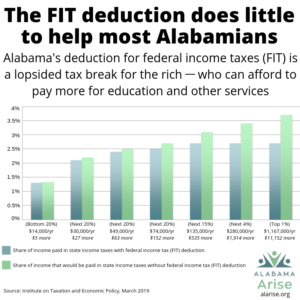
The FIT deduction is one big reason Alabama’s tax system is upside down. For those who earn $30,000 a year, the deduction saves them about $27 on average. But for the top 1% of taxpayers, the FIT break is worth an average of more than $11,000. The higher the income, the more the FIT deduction is worth for those who can most afford to pay more to fund education, health care and other vital needs.

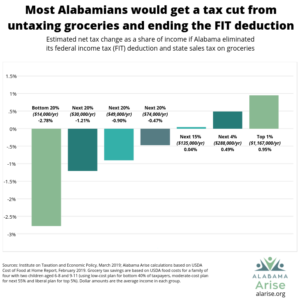
Only two other states offer a full FIT deduction like Alabama does. (Three other states offer a partial deduction.) Ending the FIT deduction would bring in an additional $719 million a year, the Institute on Taxation and Economic Policy estimates. That would be enough to allow Alabama to remove the state sales tax on groceries. For most people in our state, the net result would be a tax cut.

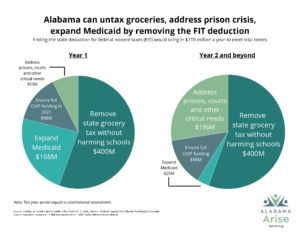
This proposal would make it easier for everyday Alabamians to make ends meet, but its benefits wouldn’t end there. Alabama also could use the new revenue to expand Medicaid, ensure full funding for the Children’s Health Insurance Program (CHIP) in 2021 and make critical investments in education and other areas. CHIP supports health coverage for more than 170,000 children through Medicaid and ALL Kids.

Alabama’s constitution dedicates income tax revenue to education, and the FIT deduction is written into the document as well. So this plan would require the Legislature and the public to approve a constitutional amendment. But ending the FIT deduction would be a good way for Alabama to begin prioritizing public investments that benefit everyone over tax breaks that primarily benefit a select few.

The real story of the House’s 2020 General Fund budget is what isn’t in it

Now that the gas tax is a reality, the Alabama Legislature appears to be in a hurry to finish up essential business – and maybe even adjourn a little early. The House on Tuesday passed a General Fund (GF) budget that differed little from Gov. Kay Ivey’s recommendations.

With Alabama finally out of the worst of the recession and revenues beginning to flow again, many legislators seem to be feeling a bit like Santa Claus. But the real story is what’s not under the GF’s tree.

The House’s GF budget, which awaits Senate action, would squeeze out increases for nearly every state agency, most of which have been living through tight times for the last decade. The state’s badly cash-strapped court system would receive nearly $40 million more, hopefully reducing its dependence on fines and fees. The Department of Corrections, facing court challenges over treatment for inmates with cognitive disabilities, would get an additional $41 million. That money would allow the department to hire an additional 500 prison guards.

Helping agencies would get increases, too. Mental health would receive an additional $9 million, as would the Department of Human Resources (DHR). The small but vital Department of Senior Services would get an additional $1 million.

Even state employees, who haven’t seen a pay increase in years, would get a 2% cost of living increase. And retired state employees would receive a one-time bonus based on the number of years served.

The head-scratcher budget request came from Medicaid. For years now, Medicaid’s funding needs have challenged previous bare-bones GF budgets. Now, during a good revenue year, Medicaid Commissioner Stephanie Azar actually requested $52 million less. Azar said the agency can carry over a considerable sum from this year to maintain current services in 2020.

The investments our state isn’t making

The 2020 GF budget does indeed look pretty good at first glance. But the House plan is conspicuous for what was not included.

Perhaps most notably, the budget doesn’t fund Medicaid expansion to cover more than 300,000 Alabama adults with low incomes. The net state cost would be $164 million in the first year and about $25 million a year thereafter. The $52 million reduction in Medicaid’s budget would have made a nice down payment on expansion.

While the Department of Corrections can hire another 500 prison guards, the real need is closer to 2,000 new guards, according to a federal court order. And the budget does not include money for the new prison construction that Ivey has urged.

Lawmakers transferred ALL Kids to the education budget for 2020 to help balance the GF budget. But House GF budget committee chairman Rep. Steve Clouse, R-Ozark, said ALL Kids will move back to the GF in 2021. That move would add to the strain that the underfunded GF budget regularly faces. To draw down available federal matching money, the Children’s Health Insurance Program (CHIP) will need $98 million more from the state in 2021 than it receives today. CHIP provides health coverage for more than 173,000 Alabama children through both ALL Kids and Medicaid.

A funding solution to help everyday Alabamians

Alabama is, quite simply, in need of new revenue. And Alabama Arise has a plan to raise that revenue while giving most residents an overall tax cut.

Alabama is one of only three states that allow taxpayers to deduct all of their federal income tax (FIT) payments from their state income taxes. This tax loophole makes little (if any) difference for families with low and moderate incomes. But it saves millionaires a whopping average of $11,327 a year in state income taxes. If Alabama ended its FIT deduction, the state would bring in an additional $719 million a year.

That new money would allow Alabama to expand Medicaid and end the state grocery tax (two long-time Arise priorities). It also would ensure full CHIP funding in 2021 and leave additional money to meet other critical needs. (Because the state constitution earmarks income tax revenue for education, some of those moves would require an amendment.)

The proposed 2020 GF budget is only flush when compared with years when the state was truly in dire straits. It’s time for our lawmakers to find the political courage to address Alabama’s needs and raise the revenue required to meet them. Ending the state’s FIT deduction would be a good first step.

Arise legislative recap: April 12, 2019

“While the General Fund budget looks really good for what it is, what it is is not enough.” Arise policy analyst Carol Gundlach breaks down what’s missing from the General Fund budget that the Alabama House passed April 9.


Arise legislative recap: March 29, 2019

Lawmakers may have been on spring break this week, but we still have plenty to discuss in our second video update of the 2019 legislative session.


Watch Arise organizing director Pres Harris discuss upcoming community forums on Medicaid expansion, as well as reminders on action you can take in anticipation of the Legislature reconvening on April 2.

Arise legislative recap: March 22, 2019

We had a problem Tuesday – and we were glad to have it. So many people came to Arise Legislative Day that we couldn’t fit everyone in the State House’s largest committee room! Nearly 300 Arise supporters came to Montgomery to tell their lawmakers that it’s time to expand Medicaid. We appreciate everyone who showed their support for this investment in a healthier Alabama.


Click above to watch Arise executive director Robyn Hyden talk about our successful Legislative Day, as well as the Senate’s vote for a bill to make Alabama’s justice system more equitable. We’re excited to build on this momentum when the Legislature returns from spring break on April 2.

Revenue options for Medicaid expansion

Alabama’s budget is an expression of our values. Medicaid expansion means healthier families, thriving communities and a stronger economy. Policymakers have a range of options for making this bold investment in a brighter future. Now is the time to choose.

Remove the state deduction for federal income taxes (FIT)

$719 million in new revenue per year

Only two other states offer a full FIT deduction

This money would allow Alabama to achieve multiple goals:

Expand Medicaid (cost: $168 million in first year, $25 million per year thereafter)*

— Remove the state sales tax on groceries (cost: approximately $400 million per year)

— Secure long-term funding for ALL Kids (cost: $38.4 million for 2020, approximately $90 million for 2021)*

Remove the state deduction for FICA payroll taxes

$261 million in new revenue per year*

Only one other state offers a full FICA deduction

Raise the cigarette tax by $1 per pack

► $180 million in new revenue in 2020

Other revenue options include:

► Make large landowners pay their fair share of property tax

► Tax sugar-sweetened beverages and vaping-related products

► Close corporate tax loopholes – for example, enact combined reporting*


* Would require transfer from Education Trust Fund to General Fund