
Closing the health coverage gap: Alabama must enact policies to save lives

Haga clic aquí para leer esto en español.

By Jennifer Harris, senior health policy advocate, and Debbie Smith, Cover Alabama campaign director

As Alabama enters the 2026 legislative session, Medicaid expansion and maternal health will be central to the state’s health equity conversations. Recent federal policy changes have made these conversations more urgent and more complex.

Alabama Arise will continue to support health investments to save lives, create jobs and protect rural residents across our state. This will include advocacy to close the state’s health coverage gap through Medicaid expansion. We also will urge lawmakers to approve legislation to protect and expand access to comprehensive maternal health care.

Federal policy changes are reshaping Medicaid financing

Alabama remains one of only 10 states yet to expand Medicaid. As a result, hundreds of thousands of Alabamians are caught in the state’s health coverage gap, earning too much to qualify for Medicaid but too little to qualify for Marketplace insurance subsidies under the Affordable Care Act (ACA).

HR 1, the so-called One Big Beautiful Bill Act, eliminated a two-year increase in the federal Medicaid match rate that was available to states that expanded Medicaid. This increased match rate was an additional incentive for states that had not yet expanded Medicaid to cover adults
with low incomes to do so.

For Alabama, the federal incentive eliminated under HR 1 would have brought an estimated $619 million in federal funding for two years. That would have been enough to cover at least the first two years of Medicaid expansion.

Without this incentive – which would have been in addition to the ongoing 90-10 federal match rate for covering residents under Medicaid expansion – expanding Medicaid will cost more. It also will require identifying new, sustainable financing sources.

Provider tax changes create additional budget constraints

Federal changes under HR 1 also restrict how states can use provider taxes to finance Medicaid. Under HR 1, Alabama would be required to reduce Medicaid provider tax collections if it expanded Medicaid in the future.

This provision could result in Alabama losing more than $100 million in health care revenue annually if the state expanded Medicaid. Arise will continue making the case that lawmakers should not pit current Medicaid enrollees against people who need coverage but cannot afford it.

Affordable coverage through Healthcare.gov remains at risk

At the same time, affordability challenges are growing for people who receive health coverage through the ACA Marketplace. Enhanced premium tax credits (ePTCs) have helped nearly 500,000 Alabamians afford coverage through Healthcare.gov. But the ePTCs expired Dec. 31, and Congress has yet to renew them.

As a result, many Alabamians’ monthly health coverage premiums will double – or increase by even more. An estimated 130,000 Alabamians are expected to lose their health coverage because of this change.

Persistent gaps in health coverage and outcomes

Nearly 200,000 adults remain stuck in Alabama’s coverage gap. And that number unfortunately is expected to grow since the ePTCs expired.

At the same time, Alabama continues to rank poorly on key health outcomes, including infant and maternal mortality. These realities make clear that coverage policy and maternal health outcomes cannot be addressed in isolation.

Building on progress to improve maternal health

Despite these systemic challenges, Alabama has made strides in improving maternal health in recent years. extending Medicaid postpartum coverage. These steps have included removing paperwork obstacles to maternity Medicaid coverage and ensuring paid family leave for state employees, K-12 teachers and two-year college workers. Lawmakers also eliminated the state sales tax on many maternity and infant items.

Here are Arise’s recommendations for next steps that legislators can take to improve maternal health care outcomes in our state:

  • Increase provider access for new moms. Alabama should act now to close maternal health deserts throughout our state. Moms in rural areas need access to birth workers, including doctors, midwives and doulas.
  • Protect access to contraceptives. Contraceptives are important to reproductive health and meeting family planning needs. These contraceptives should be readily available and affordable.
  • Ensure doctors can perform life-saving procedures and preserve fertility without fear of criminalization. Moms need safe, appropriate health care during pregnancy when complications are present. Doctors should not have to fear prosecution over providing such essential life-saving care.
  • Ensure a healthier start for newborns. Arise advocates for policies that promote a healthier start for newborns and their families. This includes support for HB 54, known as the Women’s CARE Act. This bill by Rep. Rolanda Hollis, D-Birmingham, would allow many pregnant moms sentenced to incarceration to serve supervised probation until 12 weeks after childbirth.

Bottom line

Alabama faces many difficult but important decisions about Medicaid expansion, health care affordability and maternal health. Federal policy changes have made inaction more costly, while coverage gaps and poor health outcomes continue to affect families across the state.

By addressing financing challenges, protecting access to coverage and building on recent maternal health progress, Alabama has an opportunity to move toward a more equitable health care system that better supports moms, babies and communities statewide.
Strong investments in schools, housing and transit improve life for all Alabamians

Haga clic aquí para leer esto en español.

Strong funding for public services like education and public health broadens opportunity for everyone, especially for Alabamians with low incomes. Alabama Arise members for decades have urged robust and secure state funding for these services. Arise members’ top budget priorities for 2026 include:

Public school funding

Lawmakers made important improvements to Alabama’s K-12 funding formula last year by passing the RAISE Act. The law provides additional funding for public schools that serve larger shares of students who are experiencing poverty or who have special needs. But because local property tax collections vary greatly, large resource gaps still remain in many districts.

The CHOOSE Act poses a major and growing threat to adequate funding for public schools. This law allows parents to receive up to $7,000 per child for private school and up to $2,000 for homeschooling each year. The law diverts $100 million of state money from public schools each year. But legislators could face intense pressure to increase that amount once the income limits for eligibility disappear starting in 2027.

Another key step to invest more in education would be to end or limit the state deduction for federal income tax (FIT) payments. Alabama is the only state that still allows this deduction, which is a tax break skewed heavily in favor of wealthy households.

Affordable housing

Alabama lacks more than 73,000 homes for households below the federal poverty line, leaving many residents without a safe, affordable place to live. Lawmakers created the Alabama Housing Trust Fund in 2012, but they have failed thus far to fund it. Arise will continue working to secure state funding for affordable housing and identify policy changes to strengthen housing support statewide.

Public transportation

Inadequate public transportation prevents thousands of Alabamians from meeting basic needs. Unreliable public transit can cause workers to be late for work, putting their jobs at risk. It can also force patients to miss critical medical treatments, worsening their health and adding to the state’s rural health crisis.

The Legislature created the Alabama Public Transportation Trust Fund in 2018 but has failed to fund it. A constitutional amendment also prevents gas tax money from being used for public transit. Arise will continue advocating for state funding for public transportation and will explore innovative solutions for both funding and service provision across Alabama.

Alabamians’ health care costs will soar in 2026 if Congress doesn’t act now

The clock is ticking: Enhanced Marketplace subsidies expire this year!

The enhanced Advance Premium Tax Credits (APTCs) that have made health insurance more affordable for hundreds of thousands of Alabamians are set to expire at the end of 2025. If Congress doesn’t act now, premiums for families, small business owners and people who buy their own insurance will skyrocket — forcing many to give up their high-quality health coverage and leaving many of them uninsured.

Since 2021, these expanded subsidies have helped more than 300,000 additional Alabamians enroll in coverage through the Health Insurance Marketplace (healthcare.gov) created under the Affordable Care Act. They’ve also helped reduce the burden of unpaid medical bills on hospitals and providers. Without action, we risk reversing this progress. Congress must act NOW to keep coverage affordable and accessible for all.

What’s at stake for Alabama?

‍‍ Who would be hit the hardest?

  • Small business owners and self-employed Alabamians: More than 65,000 receive their health coverage through the Marketplace.
  • Older adults and families with lower incomes would bear the brunt of skyrocketing premiums. For example, a 60-year-old Alabama couple making $82,000 would see their annual premiums for a benchmark plan increase from $6,970 to more than $27,267.
  • Households earning as little as $15,650 per year for an individual or $32,000 per year for a family of four could be priced out of coverage altogether.

Congress must act NOW

Enhanced APTCs must be extended to protect affordable health coverage for hundreds of thousands of Alabamians. Sign our petition to members of Alabama’s congressional delegation to demand they extend enhanced premium tax credits. 

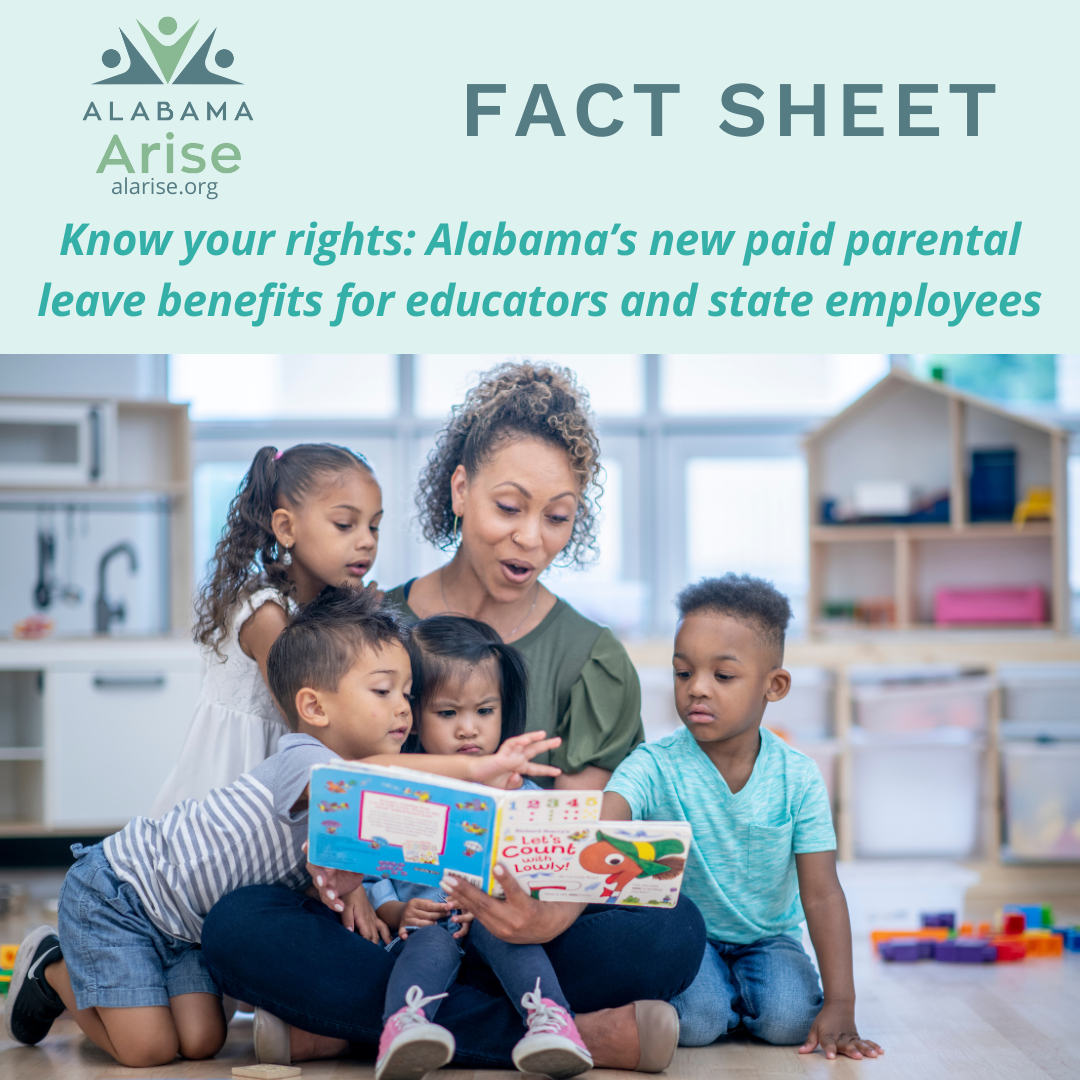
Know your rights: Alabama’s new paid parental leave benefits for educators and state employees

It’s a new day for Alabama families. As of July 1, 2025, if you are an employee of the state of Alabama, a local education agency, the Alabama Community College System or any of its institutions, you have new protections to help take care of your child and maintain your economic security under SB 199. Below is more information on what this law will mean for you.

What does SB 199 do?

  • SB 199 provides paid parental leave to state employees and employees of a local education agency, the Alabama Community College System or any of its institutions.
    • Mothers may receive eight weeks of paid parental leave in connection with the birth, stillbirth or miscarriage of a child that occurs on or after July 1, 2025. 
    • Fathers may receive two weeks of paid parental leave in connection with the birth, stillbirth or miscarriage of a child that occurs on or after July 1, 2025. 
    • The bill also allows eligible employees to take eight weeks of paid parental leave for the legal adoption that occurs on or after July 1, 2025, of a child who is aged 3 or younger at the time of placement with the eligible employee.
  • Eligible employees will receive 100% of their regular salary during this leave.

Am I covered?

  • The law covers eligible employees in Alabama who have been employed for at least 12 consecutive months immediately preceding the occurrence of a qualifying event. 
  • The following employees may be eligible:
    • Certified or uncertified employees of a local education agency (including the Board of Trustees of the Alabama Institute for Deaf and Blind),
    • Legislative personnel, officers and employees,
    • Court officials and employees of the Unified Judicial System,
    • Employees of the Alabama Community College System or any of the educational institutions under its authority and control, and
    • Certain other specified categories of workers.

What constitutes a qualifying life event?

  • The birth, stillbirth or miscarriage of a child or the legal adoption of a child who is aged 3 or younger at the time of placement with the eligible employee constitutes a qualifying life event for paid parental leave.
  • The paid parental leave must be taken either within 365 days of the qualifying event or within 365 days of the eligible employee first taking parental leave for a qualifying event, whichever occurs sooner.
  • Paid parental leave may be taken only once in a 365-day period, no matter how many qualifying events you may experience in a year.
  • Any unused paid parental leave cannot be carried over for future use during subsequent qualifying events or be otherwise paid out to the eligible employee.
  • Covered employees may elect to take paid parental leave intermittently to bond with their child over a more extended time period, as long as this agreement is in place with their employer prior to starting leave. The eligible employee must maintain a continuing parental role with any child whose birth or adoption was a qualifying event.

If both parents are eligible employees, can they each take paid parental leave?

  • Yes. If both parents work for the state, a local education agency, the Alabama Community College System or any of its institutions, they each may be able to take the applicable amount of paid parental leave in connection with the birth, stillbirth or miscarriage of their child. (See above.) In the case of legal adoption, if both parents are eligible employees, one parent may take eight weeks of paid leave and the other may take two weeks, regardless of sex.

How do I request paid parental leave benefits?

  • You should contact your supervisor or the employing entity to request paid parental leave in writing with a plan of your intended use and any other leave you intend to take. 
  • You also must agree in writing to the employing entity that you agree not to separate from employment for at least eight weeks following the conclusion of any leave taken in connection with the qualifying event. However, this may be waived in circumstances where you are unable to return to work due to a serious health condition or you are caring for an immediate family member’s serious health condition.

Can this leave be used for my pregnancy-related health needs prior to giving birth?

  • It depends. Paid parental leave can be used in connection with the birth, stillbirth or miscarriage of your child or the adoption of a young child in certain situations. Here are some examples: 
  • Attending prenatal appointments or other visits to a health care provider due to the expected birth of a child.
  • Being hospitalized in expectation of the birth or due to a condition caused by or related to the expected birth.
  • Requesting leave that is otherwise required due to a health care provider’s order to limit physical activity prior to the expected birth.
  • Meeting with an attorney regarding the adoption of the child, or hosting in-home visits necessary for the completion of the adoption.
  • Attending judicial proceedings or counseling sessions regarding the adoption.
  • Submitting to a physical exam as it relates to the adoption.
  • Traveling to another country to complete an adoption.


  • You may be able to use other forms of accrued time off or request time off or other accommodations under federal laws such as the Family and Medical Leave Act (FMLA), Americans with Disabilities Act (ADA), Pregnant Workers Fairness Act (PWFA) or Pregnancy Discrimination Act (PDA). Learn more at abetterbalance.org/states/alabama.

How does paid parental leave interact with FMLA and Alabama unpaid family leave?

  • If you qualify for FMLA and unpaid family leave under Alabama state law, paid parental leave will run concurrently with FMLA and Alabama unpaid family leave.

Do I have to use sick or vacation days beforehand?

  • No. Under this law, paid parental leave is provided in addition to any accrued paid or unpaid sick, vacation or medical leave. 
  • You do not have to use your vacation or sick days before taking paid parental leave.

Questions? Call A Better Balance’s free, confidential legal helpline at 833-NEED-ABB (833-633-3222) to speak with an attorney about your workplace rights.

What we know about the SNAP changes in the new federal budget law

The federal One Big Beautiful Bill Act does not immediately cut or end food assistance benefits for people who now receive them. People who are now getting food assistance under the Supplemental Nutrition Assistance Program (SNAP) should continue receiving their monthly benefits normally for the foreseeable future, just as they have in the past. But the law likely will harm many participants and strain state budgets in coming years.

The act includes three major types of changes to SNAP. An overview of each category is below.

1. Changes that affect state budgets

Beginning in the 2026 regular session, the Alabama Legislature will have to appropriate an estimated $35 million in new funding for SNAP administration. This is because the act will require states to cover 75% of SNAP administrative costs, up from the current 50%.

Beginning in the 2027 regular session, the Alabama Legislature will have to appropriate an estimated $172 million in new funding for SNAP benefits. This amount could be smaller or larger each year based on annual changes in the state’s SNAP “error rate,” which includes both overpayments and underpayments of SNAP benefits. The error rate is not a measurement of fraud.

The act includes a sliding scale that requires states to pay for anywhere from 0% to 15% of SNAP benefits, depending on the state’s SNAP error rate. Based on Alabama’s most recent error rate, the state would have to cover 10% of the cost of SNAP benefits, or roughly $172 million.

If Alabama lawmakers could not or would not provide the required state share of funding, the state would have to reduce the number of SNAP participants or opt out of the program entirely. Eliminating SNAP would end food assistance for more than 750,000 Alabamians who participate in the program.

Deep SNAP cuts like those would send hunger rates soaring in a state where roughly 1 in 6 people – including nearly 1 in 4 children – already struggle with food insecurity, meaning they do not always have enough to eat or know where they are going to get their next meal.

Severe SNAP cuts also could be financially devastating for many grocery stores and other retailers. If those stores responded to the revenue loss by shutting down or reducing their hours of operation, that would decrease food access in communities across our state, particularly in rural areas.

2. Changes that place new requirements and limits on more people who participate in SNAP

Many veterans, people who are experiencing homelessness and young adults who were in foster care as children may have to comply with work reporting requirements.

Adults in a household with children aged 14 or older may have to comply with work reporting requirements. We don’t know exactly when this change will happen, but people who will be affected will get notice and an opportunity to ask for an exemption.

People who are between ages 55 and 64 may have to comply with work reporting requirements. We don’t know exactly when this change will happen, but people who will be affected will get notice and an opportunity to ask for an exemption.

Some people between 60 and 65 who have received special SNAP benefits for older adults under the Alabama Elderly Simplified Application Project (AESAP) may face additional barriers to participation.

Many people who are legally in the United States as refugees or asylum seekers may no longer be eligible for SNAP. We don’t know exactly when this change will happen, but people in these categories who are participating in SNAP now should continue to get their benefits until notified of a change.

3. Changes that likely will reduce the amount of SNAP assistance over time

The law will prohibit the federal government from changing the amount of SNAP assistance by updating the USDA’s “Thrifty Food Plan,” except to keep up with inflation. The Thrifty Food Plan is used as the basis for determining SNAP benefit amounts each year. This change will reduce SNAP assistance over time but won’t affect current benefit levels.

What we know about the health care changes in the new federal budget law

While many Alabamians were preparing for the July 4 holiday, Congress passed the One Big Beautiful Bill Act — a sweeping federal budget law with serious consequences for families across the country, including right here in Alabama.

The Center on Budget and Policy Priorities put it plainly:

“House and Senate Republicans have now passed a bill that will raise families’ food and health care costs, increase poverty and hunger, take health coverage away from millions of people, and drive up deficits — all to give costly tax cuts to the wealthy and corporations.”

This law is a cruel tradeoff — and it hits hardest in places like Alabama, where many families are already stretched thin and our health care system is fragile.

What you need to know about the Medicaid cuts

We want to be clear: We do not expect anyone in Alabama to be immediately kicked off their health coverage because of this law. However, the long-term consequences are serious and far-reaching. This law makes it more difficult for people to access coverage, and it limits Alabama’s ability to strengthen our health care system in the future.

Here’s what we know so far:

  • Work reporting requirements and six-month eligibility redeterminations target adults covered through Medicaid expansion. Since Alabama hasn’t expanded Medicaid, these provisions are unlikely to affect us directly at this time. 
  • The law eliminates key financial incentives created to encourage Alabama and other states to expand Medicaid. We no longer will be eligible for $619 million in additional funding to expand Medicaid in the future, which would have helped pay for the startup costs of Medicaid expansion. 
  • The law also includes restrictions on provider taxes — a key tool Alabama uses to help fund its share of Medicaid. We believe the most harmful restrictions would only apply if Alabama chooses to expand Medicaid in the future. This provision will make it more difficult for Alabama to consider expansion going forward, and the cap on provider taxes for Alabama will put a long-term limit on how our state finances Medicaid as health care costs rise.

What’s changing on Healthcare.gov

The law also failed to renew enhanced subsidies that have made Marketplace plans under the Affordable Care Act (ACA) more affordable since 2021. These subsidies have helped thousands of Alabamians lower their monthly premiums — and thanks in part to this support, the size of Alabama’s coverage gap shrank from about 340,000 to 200,000 people. Now, those enhanced subsidies are going away at the end of 2025.

Here’s what this means:

  • Monthly premiums will increase in 2026 for many people who buy insurance on Healthcare.gov. 
  • Fewer people will qualify for financial help, especially those with lower or fluctuating incomes. 
  • It will be harder to sign up and stay covered, with shorter enrollment periods and stricter paperwork rules.

These changes make health insurance less affordable and harder to access — especially in a state like Alabama, where many people already struggle to afford care.

What this means for providers and rural hospitals

The law includes a new Rural Health Transformation Program, which allocates $50 billion over five years for rural hospitals nationwide. But how that funding will be distributed is unclear, and the funding is unlikely to be enough to meet the growing financial needs of rural hospitals.

Meanwhile, the broader impact is clear:

  • More uninsured patients will increase uncompensated care costs for providers. 
  • Hospitals and clinics will face more financial pressure — especially in rural areas. 
  • Patients may face reduced access, longer wait times and fewer services as a result.

How Alabama Arise and Cover Alabama are taking action

Alabama Arise and the Cover Alabama team are taking numerous steps in response to the passage of this law. These actions include:

  • Analyzing the law’s long-term impact on Medicaid financing, ACA Marketplace access and Alabama’s health care infrastructure. 
  • Creating resources for partners, community organizations and the public to explain the changes and what they mean. 
  • Meeting with state and local leaders to discuss options and ensure they understand the financial and human stakes of these changes. 
  • Offering presentations and briefings across the state to help Alabamians prepare and respond.

Even in the face of harmful federal policy, our commitment to the people of Alabama is strong. We are working every day to protect access to care and make sure families have the information and support they need.

We will keep moving forward — and we’ll do it together.

Federal budget bill would endanger state budgets, increase hunger for 750,000+ Alabamians

The U.S. House in May passed legislation that would take food assistance away from many Alabamians who are already struggling to afford groceries. A U.S. Senate committee in June approved similar legislation. These cuts would help pay for extending huge tax breaks for the wealthiest households. The bill would target the Supplemental Nutrition Assistance Program (SNAP) for the largest cut in its history. People living in rural, urban and suburban areas across Alabama all would pay the price.

This bill would harm people across our state. Here is what’s at stake for Alabama:

Passes the buck for SNAP funding to the Alabama Legislature.

The bill could require Alabama to pay between 5% to 15% of SNAP benefit costs, which would cost the General Fund an estimated $86 million to $258 million a year. In addition, states would have to come up with additional administrative funds for SNAP, which could add another $35 million to Alabama’s costs. This unfunded mandate could force legislators to reduce SNAP benefits, limit SNAP participation and/or cut funding for other vital services. In a worst-case scenario, the state could opt out of SNAP entirely, ending food assistance for nearly 800,000 Alabamians. That would send hunger soaring and devastate grocers, especially in rural areas.

Takes food assistance away from many families with young children.

Tens of thousands of Alabamians with school-aged children would be at risk of losing some or all of their food assistance. This would result from an expansion of red-tape time limits to parents and other caretakers of children aged 14 and older.

Takes food assistance away from many veterans and homeless people

The bill approved by the Senate committee would deny SNAP assistance to refugees, people granted asylum, and some victims of domestic violence, sex trafficking or labor trafficking. It also would impose stringent time limits on many SNAP participants – including veterans, people who are homeless and children aging out of foster care – who cannot comply with complex paperwork requirements.

Reduces SNAP benefits over time for everyone receiving food assistance.

The bill effectively would freeze the value of SNAP benefits at their current level unless Congress voted otherwise. This would make it harder for families to keep up with rising food costs in years when those costs increase more than inflation.

Updated June 25, 2025, to reflect proposed changes in the U.S. Senate.

Federal budget bill threatens health coverage for 190,000 Alabamians

A bill passed by the U.S. House would put the health of thousands of Alabamians — and the state’s fragile health care system — at serious risk.

Here is what’s at stake for Alabama:

190,000 Alabamians could lose coverage

The bill would make cuts to Medicaid and would raise premiums through the Health Insurance Marketplace. As a result, thousands of Alabamians may lose their health insurance, and many would be forced to skip medications, delay care or go to the ER in crisis.

$1.14 billion hit to Alabama’s economy

Raising premiums by letting enhanced Affordable Care Act (ACA) premium subsidies expire would shrink Alabama’s economy by $1.14 billion and cost the state 10,000 jobs in 2026.

Blocks Medicaid expansion funding

The bill would eliminate $619 million in federal funds set aside to help Alabama expand Medicaid. This would deny Alabama the chance to cover at least 200,000 more residents – including veterans, college students, caregivers and more.

Pushes Alabama’s health care system closer to collapse

Alabama’s health care infrastructure is already stretched thin – with at least 20 rural hospitals already at risk of closing. This bill would put more than $400 million per year in state Medicaid provider taxes at risk. As a result, our state lawmakers could be forced to cut coverage or raise new taxes to fill the gap.

Raises health care costs for everyone

When people lose coverage, hospitals and providers still deliver care — but with no reimbursement. That means higher health care costs for everyone — no matter what type of coverage you have.

Vote ‘Yes’ on HB 386: Help Alabama families by reducing the state grocery tax

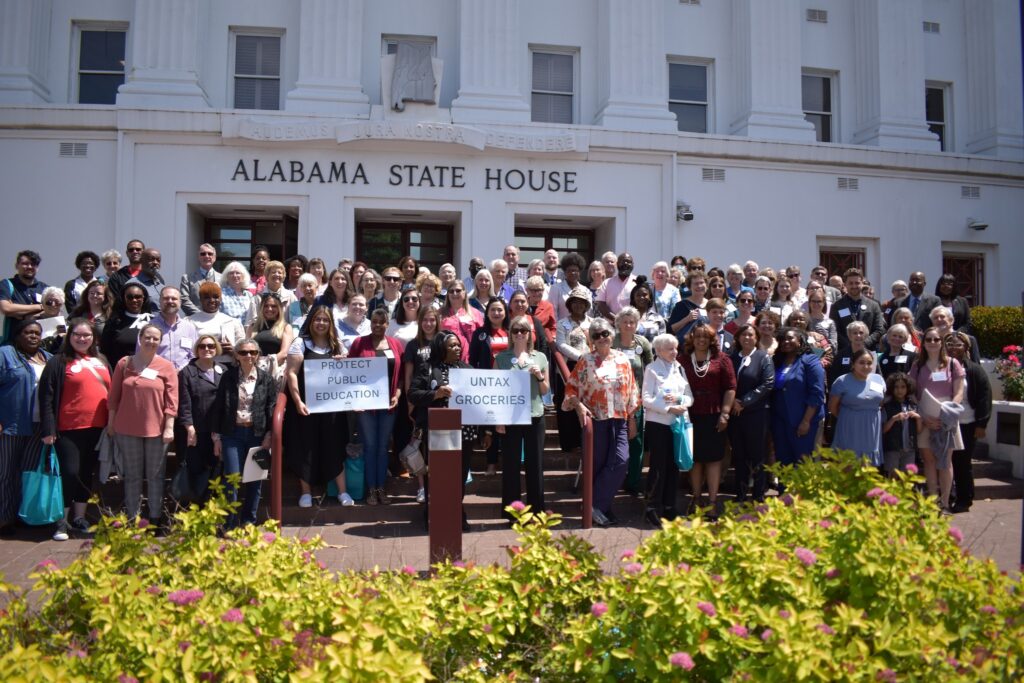
Alabama Arise supporters gather outside the State House in Montgomery during Arise’s Legislative Day on April 11, 2023. More than 100 Alabamians came to urge their legislators to end the state sales tax on groceries. Lawmakers reduced the state grocery tax from 4% to 3% in 2023 and now are considering another reduction in 2025.

Why Alabama needs to untax groceries

  • The grocery tax increases hunger rates and drives many struggling families deeper into poverty.
  • Alabama’s tax system is upside down. On average, people with low incomes pay a much higher share of their income in state and local taxes than the wealthiest households do.
  • The grocery tax is a major reason that Alabama’s tax system is so upside down. Grocery taxes take a much bigger bite out of household budgets for Alabamians with low and middle incomes than for wealthier people.
  • Most states have rejected the grocery tax. Alabama is one of only 10 states still taxing groceries.

How HB 386 would help people across Alabama

  • HB 386 by Rep. Danny Garrett, R-Trussville, would reduce the state sales tax on groceries from 3% to 2% starting on Sept. 1, 2025. This would build on the progress made in 2023, when the Legislature reduced the tax from 4% to 3%.
  • Reducing the state grocery tax by 1 percentage point would save an average Alabama family of four about $125 to $150 a year.

Bottom line

Alabama’s grocery tax is a cruel tax on survival. Lawmakers should pass HB 386 to continue the progress toward eliminating the state grocery tax once and for all. And they should work to identify more sustainable, less harmful options to fund public education and other vital services.

Vote ‘No’ on SB 84 and HB 477: Junk health plans are not the solution for Alabama’s health coverage gap

Junk health plans lack basic consumer protections.

  • SB 84 and HB 477 would allow a “nonprofit agricultural organization” to offer unregulated health plans to its members in Alabama. The bill explicitly says these benefits would “not [be] provided through an insurance policy.”
  • Unlike health insurance sold by other carriers, plans like the ones offered under SB 84 and HB 477 could deny someone health coverage based on previous medical history. If people with preexisting conditions are accepted, they could be charged a higher premium and/or not have coverage for care related to their preexisting conditions.
  • These new plans could put caps on key benefits, and they would not have to limit annual and lifetime out-of-pocket costs for consumers. This could leave patients with massive medical bills or force them to forgo needed treatment.

Junk health plans lack financial oversight.

  • Plans under SB 84 and HB 477 would lack the financial requirements that Marketplace insurance has.
  • The plans could charge whatever prices they want without regulatory oversight, and they would not have to spend a minimum share of the money they collect on medical care.

Junk health plans are not a solution for closing Alabama’s health coverage gap.

  • Alabamians deserve health coverage that delivers stable, high-quality insurance they can afford to use when illness strikes. This coverage should include a full set of benefits to protect people when they become sick, and it should be available regardless of one’s medical history to prevent discrimination.
  • Good health coverage should be properly regulated to ensure that customers’ financial and medical interests are protected.
  • The plans offered under SB 84 and HB 477 would not ensure affordable or adequate health coverage for the nearly 200,000 Alabamians in our state’s coverage gap. Lawmakers should focus instead on boosting our state’s workforce by expanding Medicaid coverage to ensure every Alabamian can get the health care they need to survive and thrive.

Updated March 25, 2025, to add references to HB 477.