CHOOSE Act will further hurt Alabama’s public schools

Many Alabamians think of public education as a natural part of growing up and of community life. Public schools are at the center of hundreds of communities across our state. And their calendars often set a rhythm for the flow of the year: football games in the fall, band concerts and theater productions in the winter, proms in the spring and graduation ceremonies in May.

So it might surprise most Alabamians to know the Alabama Constitution – our foundational document – does not guarantee our children a right to public education. And despite our pride in our local schools, Alabama historically has failed to fund those schools adequately.

Thirty-nine states and the District of Columbia spend more in state and local funds per student than Alabama. And despite legislative boasts that Alabama education budgets have hit record high, our state funding for K-12 schools since 2009 has failed to keep up with inflation.

Now a new law will make that underinvestment even worse. Alabama’s public schools took a big funding hit in 2024 when the Legislature passed the Creating Hope and Opportunity for our Students’ Education (CHOOSE) Act. The CHOOSE Act will give parents a refundable tax credit of up to $7,000 per child for private school or homeschooling. Parents will be eligible for the credit regardless of whether their child has ever been enrolled in a public school. And in a few years, every parent in Alabama will be eligible, no matter how high their income may be.

Because the tax credit is refundable, parents can receive more money for private school tuition than they actually paid in taxes. The money for these “education savings accounts” – essentially school vouchers by another name – will come from sales and income tax revenues that otherwise would go to Alabama’s public schools under the Education Trust Fund (ETF).

How the CHOOSE Act became law

Lawmakers laid the foundation for the CHOOSE Act in 2013 when they hurriedly passed the Alabama Accountability Act (AAA). That law created a limited number of tax credits to subsidize private school tuition, with priority given to parents of children zoned for so-called “failing schools.” Many of these schools serve disproportionate shares of Black and Hispanic students and are located in communities with high poverty rates and a history of state underinvestment. The AAA also gave tax breaks for donations to some groups that give scholarships to pay for private school tuition. State law caps the total amount of AAA tax credits at $40 million annually, with flexibility for that amount to increase to $60 million eventually.

The CHOOSE Act will cost much more, and it is part of a broader nationwide legislative push by conservative activists. More than a dozen states have passed school voucher bills, spurred by ideology rooted in hostility to public education and a misplaced belief that competition improves education. Vouchers for private education are also a key recommendation in the Heritage Foundation’s Project 2025.

In her 2024 State of the State address, Gov. Kay Ivey said, “Passing an education savings account bill … is my number one priority.” The Legislature responded by passing the CHOOSE Act early in the session. Alabama Arise testified against the legislation in both House and Senate committee hearings, but lawmakers fast-tracked the bill to Ivey. She signed it into law in March 2024.

Tax credits eventually will go to all families, regardless of income

Even the wealthiest Alabamians will qualify for CHOOSE Act tax credits – and even if their children never attended public school. Beginning in the 2025 school year, eligibility for education savings accounts under the act will extend to families with incomes below 300% of the federal poverty level (approximately $77,460 for a family of three in 2024). But beginning in the 2027 school year, there will be no income limits to receive the taxpayer funds for private school.

Children raising hands in a classroom. Children who have special needs, whose parents are active duty service members, or whose siblings already receive a tax credit will have priority. But the law does not require that participating families ever have sent a child to public school. So parents who are already paying private school tuition will become eligible for taxpayer subsidies for their existing private school enrollment.

And because the act places no limit on how many families can get tax credits, almost every applicant will be eligible – with one exception. Undocumented parents and their children are ineligible for the tax credits. Even if the children are American citizens, and even if the parents are paying state, local and federal taxes.

The only limit on the CHOOSE Act’s cost is how much money the Legislature is willing to spend on it. The law requires lawmakers to allocate at least $100 million a year for tax credits under the plan. But without a cap on the overall amount of CHOOSE Act credits, legislators quickly could face enormous pressure to divert much more ETF money away from public schools.

Concerns about a lack of oversight

Schools that receive taxpayer subsidies under the CHOOSE Act will have relatively little public oversight. The act requires much less accountability from private schools than is required from Alabama’s public schools.

Schools that receive funds from education savings accounts are prohibited from discrimination based on race, color or national origin. But the law is silent on their ability to discriminate on the basis of gender, gender identity, sexual orientation or disability status. And while the act names children with special needs as priorities for education savings accounts, private schools – unlike public schools – have no obligation to admit children with special needs.

Schools that receive CHOOSE Act subsidies must be accredited. But a wide list of potential accreditation agencies exists, and the law provides no guarantee that a child will receive an education equivalent to that provided by public schools. Similarly, a standardized assessment of student progress is required, but the assessment now required for public school students is not required for private school students using education savings accounts.

Schools that receive funds under the CHOOSE Act are specifically allowed complete autonomy in designing their curriculum, including religious instruction. And the act does not explicitly forbid these schools to discriminate based on religion in employment and admission policies.

The CHOOSE Act will take money out of public schools

The CHOOSE Act will take a minimum of $100 million from Alabama’s public schools every year starting in fiscal year 2026. This would be a devastating financial blow for underfunded K-12 schools across our state.Chalkboard art with text that reads: :The CHOOSE Act will take a minimum of $100 million from Alabama’s public schools every year starting in fiscal year 2026."
That’s bad enough. But things could get much worse: The law does not cap how much can be spent on education savings accounts. And the CHOOSE Act specifically states legislators’ intent to increase expenditures whenever the demand for tax credits exceeds 90% of the allocated funds in the prior year. As accountants across Alabama begin urging their clients to pursue tax credits to help cover the cost of their children’s private school tuition, lawmakers could face intense pressure to allocate significantly more for education savings accounts.

If the takeup of these accounts is high enough, the CHOOSE Act could drain hundreds of millions of dollars each year from the ETF budget and from our public schools. That could lead to larger class sizes and less money for textbooks, technology, school maintenance and other investments in Alabama children’s educational success.

This gutting of money from public schools has played out in other states that have adopted similar programs. In Arizona, education savings accounts were forecast to cost $33 million in the first year and $65 million in the second. Actual costs were more than 10 times higher: nearly $600 million in the first year and more than $700 million in the second. In New Hampshire, costs exploded from an estimate of $300,000 in the first year to more than $8 million in the first year to $25 million in the third.

School ‘choice’ doesn’t improve student achievement

Studies of school achievement have shown that public support of private education doesn’t necessarily lead to higher student achievement or better test scores. Instead, increases in school funding, especially dollars targeted to children with the greatest needs, do improve test scores, graduation rates and post-graduation wages.

The Alabama Legislature is studying the formula by which our state funds public education, with an eye toward increasing equity and opportunity. Any diversion of money to private schools only hurts our efforts to achieve more equitable funding for public schools.

Bottom line

Alabama needs to invest in high-quality public schools focused on meeting the needs of children who live in poverty or face other educational barriers. And our state needs to reject efforts to divert public education dollars to subsidize wealthy households and benefit unaccountable private schools. The CHOOSE Act was the wrong choice for Alabama families, and lawmakers should either drastically reform it or repeal it.
Expand Medicaid to save moms and babies in Alabama

Where you live shouldn’t impact whether you get health care. But many women face preventable barriers to obtaining maternal health care in Alabama. Closing Alabama’s health coverage gap through Medicaid expansion is an essential part of the solution.

Alabama has experienced a steady rate of labor and delivery department closures in recent years, creating several maternity care deserts in Alabama.

  • A maternity care desert is defined as a county or area with a lack of access to maternity care resources. These areas often have no obstetric providers and no birth centers or hospitals offering obstetric care.
  • More than one-third of Alabama counties are maternity care deserts, with some people having to drive up to 100 miles to reach the nearest labor and delivery department. The lack of essential delivery and prenatal care in the Black Belt and other areas worsens the state’s maternal and infant health disparities, especially for women with low incomes.
  • Since October 2023, at least four hospitals have closed their labor and delivery departments.

The closure of accessible labor and delivery departments is dangerous for mothers and babies.

Expanding Medicaid would help strengthen access to maternity care providers by improving rural hospitals’ overall finances, which could reduce the number of labor and delivery department closures in the state.

Alabama has the highest maternal mortality rate in the nation. Similarly, Alabama’s infant death rates are higher than those in most other states. Alabama has the nation’s third highest infant death rate.

Medicaid expansion can help address the high maternal mortality rate and health disparities in Alabama by ensuring continuous coverage before, during and after pregnancy.

  • Medicaid expansion would provide more women with access to regular prenatal checkups, leading to early detection and management of potential health issues for both the mother and the baby.
  • Research shows that adoption of Medicaid expansion is associated with lower rates of maternal mortality, and reduction in infant mortality as well.
  • Medicaid expansion also has been found to increase preconception health counseling, folic acid intake and postpartum contraception.

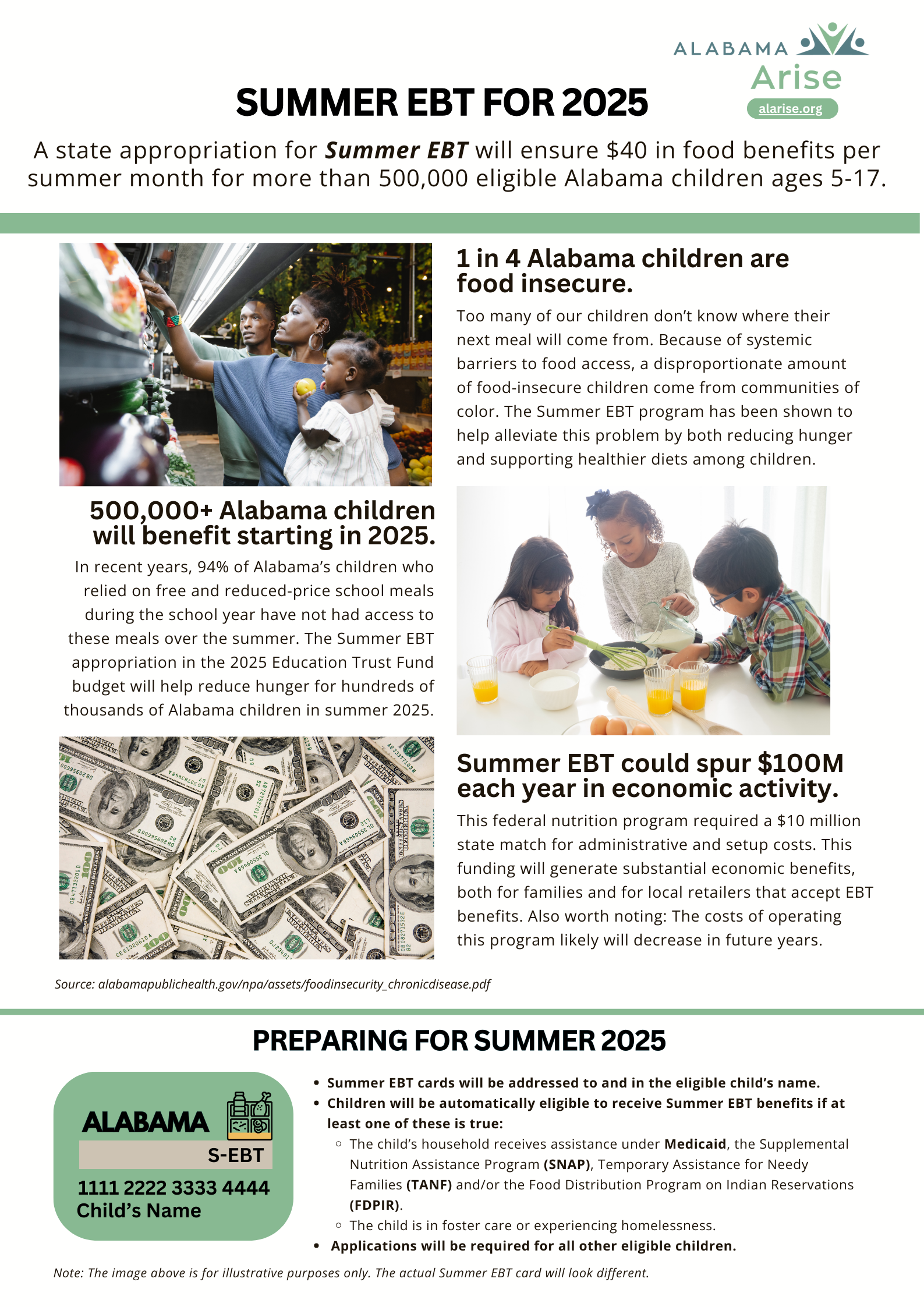
Summer EBT for 2025

A state appropriation for Summer EBT will ensure $40 in food benefits per summer month for more than 500,000 eligible Alabama children ages 5-17.


An Alabama Arise flyer explaining the need for and benefits of Summer EBT starting in 2025.

1 in 4 Alabama children are food insecure.

Too many of our children don’t know where their next meal will come from. Because of systemic barriers to food access, a disproportionate amount of food-insecure children come from communities of color. The Summer EBT program has been shown to help alleviate this problem by both reducing hunger and supporting healthier diets among children.

500,000+ Alabama children will benefit starting in 2025.

In recent years, 94% of Alabama’s children who relied on free and reduced-price meals during the school year have not had access to these meals over the summer. The Summer EBT appropriation in the 2025 Education Trust Fund budget will help reduce hunger for hundreds of thousands of Alabama children in summer 2025.

Summer EBT could spur $100M each year in economic activity.

This federal nutrition program required a $10 million state match for administrative and setup costs. This funding will generate substantial economic benefits, both for families and for local retailers that accept EBT benefits. Also worth noting: The costs of operating this program likely will decrease in future years.

Preparing for Summer 2025

  • Summer EBT cards will be addressed to and in the eligible child’s name.
  • Children will be automatically eligible to receive Summer EBT benefits if at least one of these is true:
    • The child’s household receives assistance under Medicaid, the Supplemental Nutrition Assistance Program (SNAP), Temporary Assistance for Needy Families (TANF) and/or the Food Distribution Program on Indian Reservations (FDPIR).
    • The child is in foster care or experiencing homelessness.
  • Applications will be required for all other eligible children.


Close the health coverage gap for Alabama’s veterans

Many Alabama veterans face preventable barriers to obtaining health care. Closing our state’s health coverage gap through Medicaid expansion is an essential part of the solution.

Approximately 10,000 Alabama veterans are uninsured.

  • In 2022, half of Alabama veterans who were uninsured had an income below 138% of the federal poverty level (FPL), which is the income eligibility limit for coverage through Medicaid expansion.
  • In addition to uninsurance and other barriers to accessing health care that veterans face, VA health coverage is limited as well. This is due to eligibility based on service-connected disability, income status and other service-related factors. Distance to a VA facility also poses a significant barrier that can prevent enrollment in VA health care.
  • Lack of health coverage most greatly affects the veterans who need it most. Veterans with previously existing disabilities have a higher uninsured rate than veterans in general.

In 2022, 3,004 Alabamians on active duty for training in the National Guard or Reserves were uninsured and had an income under 138% FPL.

Expanding Medicaid would empower more of our brave service members and veterans with low incomes to access health care.

  • In states that expanded Medicaid at the time, 50% of the veterans who were uninsured in 2013 received health coverage by 2015. In Alabama, only a little more than 1 in 3 uninsured veterans obtained coverage in the same time period.
  • In 2021, half of all uninsured veterans were from the 14 states that had not expanded Medicaid at that time.
  • One veteran explained the stakes of Medicaid coverage in a KFF report: “If I didn’t have Medicaid, it would be all downhill because there are not a lot of places that can afford to supply the medications that I need. Hypertension killed both my parents, so I need to take care of myself and see the doctor regularly.”

Medicaid expansion would promote employment among veterans.

  • The employment rate for veterans will be higher in states that expand Medicaid than in states that do not, as indicated by Urban Institute projections for 2024.
  • About 1 in 7 veterans (14.2%) are employed in the service industry, while 13.7% work in construction and maintenance. These are among the professions where the most workers would benefit from Medicaid expansion. Closing Alabama’s coverage gap would allow more veterans to obtain and retain employment by improving their health and productivity.

Medicaid expansion would allow veterans to have more options to receive health care.

  • Expanding Medicaid would ensure veterans have more freedom to seek health care outside of the VA system. This would allow them to receive care more promptly while reducing wait times in VA facilities for other veterans.
  • The number of VA health system outpatient visits would decrease by 12% if all states expanded Medicaid.

Summer EBT for 2025

A $15 million appropriation for Summer EBT would reduce hunger by providing eligible Alabama children $40 per summer month for food.

1 in 4 Alabama children are food insecure.

Hundreds of thousands of Alabama children don’t know where their next meal will come from. And a disproportionate amount of food insecure children come from communities of color. The Summer EBT program has been shown to help alleviate this problem by reducing hunger and supporting healthier diets among children.

545,000 Alabama children will miss meals this summer.

Providing funding for Summer EBT would ensure that hundreds of thousands of Alabama children don’t have to go hungry next summer. In recent years, 94% of Alabama’s children who received free or reduced-price school meals during the school year did not have access to these meals over the summer.

Summer EBT could spur around $100 million in economic activity.

This program would require an initial appropriation of $15 million yet will deliver a substantially higher return on investment. This appropriation could come from either the Education Trust Fund or the General Fund. Also worth noting: The costs of operating this program would decrease in future years.

Call center* – $5 – 8 million
EBT cost* – $4 – 5 million
DHR expenses* – $500,000
Application administration** – $9.5 – 15.5 million (website design, interface, hearings, QC, notices)
Department of Education expenses* – $1 million

Total = maximum of $30 million
State share = 50% | maximum of $15 million

* Cost estimates are based on Alabama’s experience with similar characteristics of Summer P-EBT cost from 2020-2024
** Cost estimates are based on new criteria in Summer EBT rules and similar vendor cost provided from other states participating in 2024

Summer EBT key points:

  • Summer EBT (Electronic Benefits Transfer) provides eligible children $40 per summer month ($120 total).
  • 1 in 4 Alabama children are food insecure, with a disproportionate amount coming from households of color.
  • 94% of Alabama children who receive free or reduced-price meals do not have access to them over the summer.
  • Summer EBT is a $15 million state investment in child nutrition, with a $1 for $1 federal match, that could spur around $100 million in economic activity annually across Alabama.
  • The Summer EBT program could reduce hunger and support healthier diets for more than half a million (545,000) Alabama children.

Investing in the Public Transportation Trust Fund

Inadequate funding for public transportation keeps thousands of people across Alabama from meeting basic needs. Unreliable bus systems cause people to be late for work, risking the loss of their jobs. If parents have a car that breaks down in rural Alabama, their children may miss doctors’ appointments, school and other activities because public transit options are booked well ahead of time. Older Alabamians with no car may be unable even to buy groceries. Without reliable rides, people needing medical care miss check-ups and treatments, worsening Alabama’s rural health crisis.

Even when transit systems work, they fall far short of meeting public needs. No public transit system in Alabama operates past 11 p.m., even on weekends. And many rural lines operate by appointment only from 9 a.m. to 5 p.m. on weekdays. Alabama must do more to meet the challenge of connecting its people to jobs, education and services.

A 1952 amendment to Alabama’s constitution (Amendment 93) makes it illegal to use state gasoline tax revenues for anything other than building and maintaining roads and bridges. As a result, the most logical source of state funding for transit, a source all our neighboring states use, remains off limits in Alabama. Without dedicated state transit funding, Alabamians will continue to lack public transportation options that residents of other states enjoy. Building a modern public transit infrastructure certainly would provide a job-creating boost for economic development.

The Alabama Public Transportation Trust Fund (PTTF), created in 2018, could help fix our transit issues, but the Legislature has never funded it. The return on transit investment would make this a wise use of public funds. Every $1 million invested in transit creates 49 full-time jobs, which are long-term jobs with good pay. A state appropriation of $50 million would allow Alabama to harness up to $200 million in federal matching funds for capital improvements, and it could double the investment for operations expenses.

BOTTOM LINE: Alabama public transit needs state investment to provide the same services as our neighboring states. Now is the time to invest in public transportation and ensure all Alabamians can get where they need to go.

Support SB 91 to fund public transit, increase workforce participation and improve lives

Alabama is late to the table on state funding for public transit. All four of our neighboring states fund public transportation.

Our state leaves millions in federal matching funds on the table every year. The federal matching rate for capital improvements is up to 400% of state investment. For operations, federal grants can double state investment.

Every $1 million spent on operations creates 50 jobs. These jobs provide good benefits and an average operator’s salary of more than $70,000.

Alabama’s public transit options are limited because of the lack of public funds. No Alabama public transit service operates past 11 p.m., even on weekends.

Companies and workers identify transportation needs as one of the biggest current barriers to workforce participation.

What would SB 91 do if passed?

Passing SB 91 would provide a dedicated funding source for public transit needs. SB 91 would provide about $25 million in state funding each year to the Public Transportation Trust Fund (PTTF), which the state created in 2018 but has not yet funded.

With the federal match, SB 91 would fuel up to $125 million worth of transit projects every year. These investments would create high-quality, stable jobs and help build infrastructure to support Alabamians’ workforce participation.

Flexibility in the PTTF would allow the state to help stabilize struggling rural counties while also supporting infrastructure needs in rapidly growing regions.

It’s time to expand Medicaid and close Alabama’s coverage gap

  1. Nearly 300,000 Alabamians with low incomes would benefit from Medicaid expansion.

  • People in the coverage gap earn too much to qualify for Medicaid, but not enough for an affordable private health insurance plan on the Marketplace. This leaves them in the health coverage gap.
  • The vast majority of people who would gain coverage through Medicaid expansion are working. More than 100,000 Alabamians in the coverage gap hold jobs that are important but pay low wages. Thousands more are self-employed, serve as caregivers or attend school.
  1. We can afford it. Closing the health coverage gap comes with a $619 million signing bonus.

  • States that close their coverage gap will receive a 5-percentage-point increase in the federal match rate for Medicaid for two years. This is thanks to an incentive in the American Rescue Plan Act.
  • An increased federal match rate would bring $619 million to Alabama over the next two years.
  • The state’s cost to close the gap in the first two years would be roughly $423 million. That means nearly $200 million in additional federal funding would come to our state above and beyond the cost to extend Medicaid coverage up to hard-working Alabamians.
  1. Closing the coverage gap helps workers stay employed.

  • Nearly half of Alabama workers do not get employer-sponsored health insurance. Closing the coverage gap could help employees get access to the health care services they need.
  • States that have closed the coverage gap have seen a greater increase in labor force participation among people with low incomes than in non-expansion states.
  • Injuries or manageable illnesses like diabetes can get so severe for those without health coverage that they prevent people from working or leading healthy lives.
  1. Nineteen rural hospitals are at immediate risk of closing. Medicaid expansion can keep them operating.

  • Alabama’s rural hospitals are on life support, but research shows that a rural hospital being located in a Medicaid expansion state decreases the likelihood it will close by an average of 62%.
  • Expanding Medicaid will help more rural residents afford health care services and reduce the financial losses experienced at hospitals from serving uninsured patients or providing uncompensated care.
  1. 5,000 Alabama veterans have no military insurance and can’t afford health coverage.

  • It’s a common misconception that people who serve in the U.S. military automatically receive lifetime eligibility for health coverage and other benefits. In reality, veterans’ health benefits depend on their length of service, military classification, type of discharge and other factors.
  • 14.2% of veterans are employed in the service industry, while 13.7% work in construction and maintenance. These are among the professions that would most benefit from Medicaid expansion.

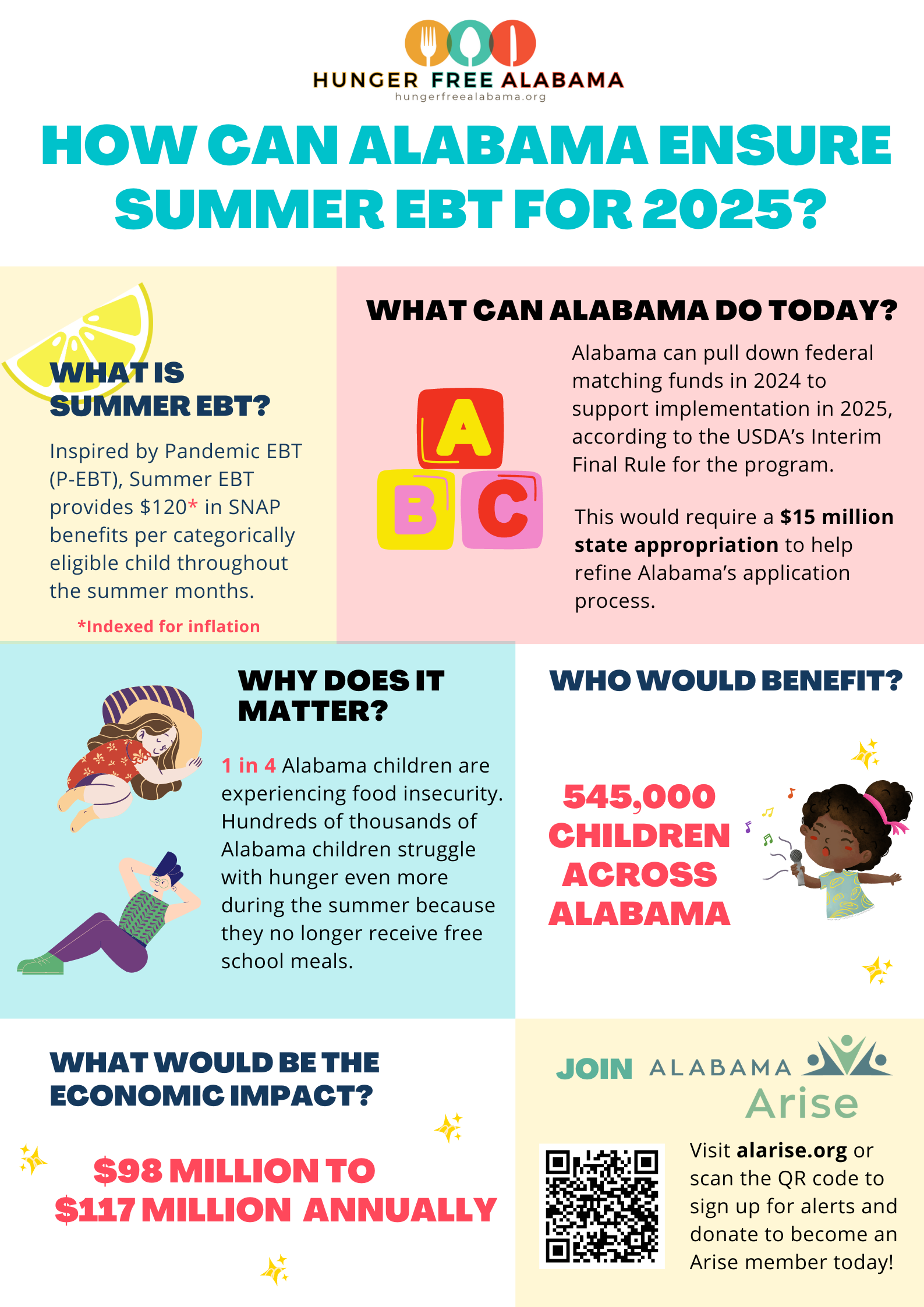
How can Alabama ensure Summer EBT for 2025?

What is Summer EBT?

Inspired by Pandemic EBT (P-EBT), Summer EBT provides $120* in SNAP benefits per categorically eligible child throughout the summer months. (*Indexed for inflation). 

What Can Alabama Do Today? 

Alabama can pull down federal matching funds in 2024 to support implementation in 2025, according to the USDA’s Interim Final Rule for the program.

This would require a $15 million  state appropriation to help refine Alabama’s application process.

Why Does it Matter? 

1 in 4 Alabama children are experiencing food insecurity. Hundreds of thousands of Alabama children struggle with hunger even more during the summer because they no longer receive free school meals.

Who Would Benefit? 

545,000 children across Alabama

What would be the Economic Impact?

$98 Million to $117 Million annually

Join Alabama Arise 

Visit alarise.org to sign up for alerts and donate to become an Arise member today!

It’s time for Alabama to prove we care about mothers and children

Healthy parents and healthy children mean a healthier future for Alabama. Comprehensive maternal and infant health care investments are crucial to ensure the health and safety of both infants and Alabamians of child-bearing age, especially postpartum mothers, pregnant women and future mothers.

Alabama Arise envisions a world in which each successive generation is ensured a secure and healthy future. By adopting policy solutions to increase the number of health care providers and extend health coverage to more people, Alabama lawmakers can help turn that vision of a brighter future into a reality.

A deadly problem

Alabama has the highest maternal mortality rate in the nation. Similarly, Alabama’s infant death rates are higher than those in most other states. Alabama has the nation’s third highest infant death rate, behind only Mississippi and Arkansas.

Another sobering fact accompanies these stark realities: Black infants and Black Alabamians who give birth experience higher mortality rates than their white and Hispanic counterparts. In fact, the infant mortality rate for Black babies is 1.5 times higher than the state average and nearly twice as high as the infant mortality rate for white babies. Similarly, Black mothers in Alabama are twice as likely to die during childbirth as their white counterparts.

Contributing factors

No one specific factor is solely responsible for the poor maternal and infant outcomes in Alabama. Rather, numerous challenges have combined to cause and worsen the situation. Listed below are a few of the key ones.

Maternity care deserts: Perhaps the most alarming factor is the prevalence of maternity care deserts in Alabama. A maternity care desert is defined as a county or area where there is a lack of access to maternity care resources. These areas often have no obstetric providers and no birth centers or hospitals offering obstetric care.

More than one-third of Alabama counties are maternity care deserts, with some people having to drive up to 100 miles to reach the nearest labor and delivery department. The lack of essential delivery and prenatal care in the Black Belt and other areas worsens the state’s maternal and infant health disparities, especially for women with low incomes.

Lack of Medicaid expansion: Alabama has a high rate of women of childbearing age who are uninsured. Nearly 300,000 Alabamians find themselves in the state’s health coverage gap. They make too much money to qualify for Medicaid, yet too little to afford private health insurance. In Alabama, 1 in 6 women aged 18 to 44 – or roughly 16% – are uninsured.

Alabama has the nation’s sixth highest rate of uninsured women of childbearing age. Research shows that Medicaid expansion is associated with lower rates of infant and maternal mortality as well as with improvements in preconception health care access and health care use before pregnancy. But Alabama remains one of only 10 states that have not expanded Medicaid to cover adults with low incomes.

Limitations resulting from state policies: Across the nation, the leading cause of infant mortality is birth defects. One in five infant deaths results from severe birth defects. But Alabama fails to screen many newborns for several rare but treatable diseases. One likely reason for that shortcoming is a lack of dedicated state funding for such screenings.

Chemical endangerment laws also lead many doctors to forgo screenings that could help catch addiction-related issues for expecting parents. Instead of incentivizing appropriate screening, treatment and harm reduction, these laws criminalize addiction and cause more harm, according to the Alabama Maternal Mortality Review Committee.

Administrative choices for Medicaid: Numerous other policy changes could promote better health for parents and infants across Alabama. Among the March of Dimes’ recommendations are “improved integration of the midwifery model of care, reimbursement for doula care, and increasing the availability of telehealth services.” Medicaid also could allow reimbursement for donor breast milk.

Impacts of the abortion ban: Alabama’s abortion ban is considered one of the nation’s most restrictive. Infants born in states with the most restrictive abortion laws are “significantly more likely to die before their first birthday than [a]re those born in states with no restrictions,” a 2020 study in the International Journal of Environmental Research and Public Health found. In addition, the exceptions to Alabama’s ban are inadequate to protect the health of the parent.

Where do we go from here?

Alabama Arise is committed to learning more about and advocating for policy solutions to improve maternal and infant health outcomes in the state. This will include advocacy for Medicaid expansion to close Alabama’s health coverage gap. We also will monitor and aim to support administrative efforts to promote better maternal and infant health.

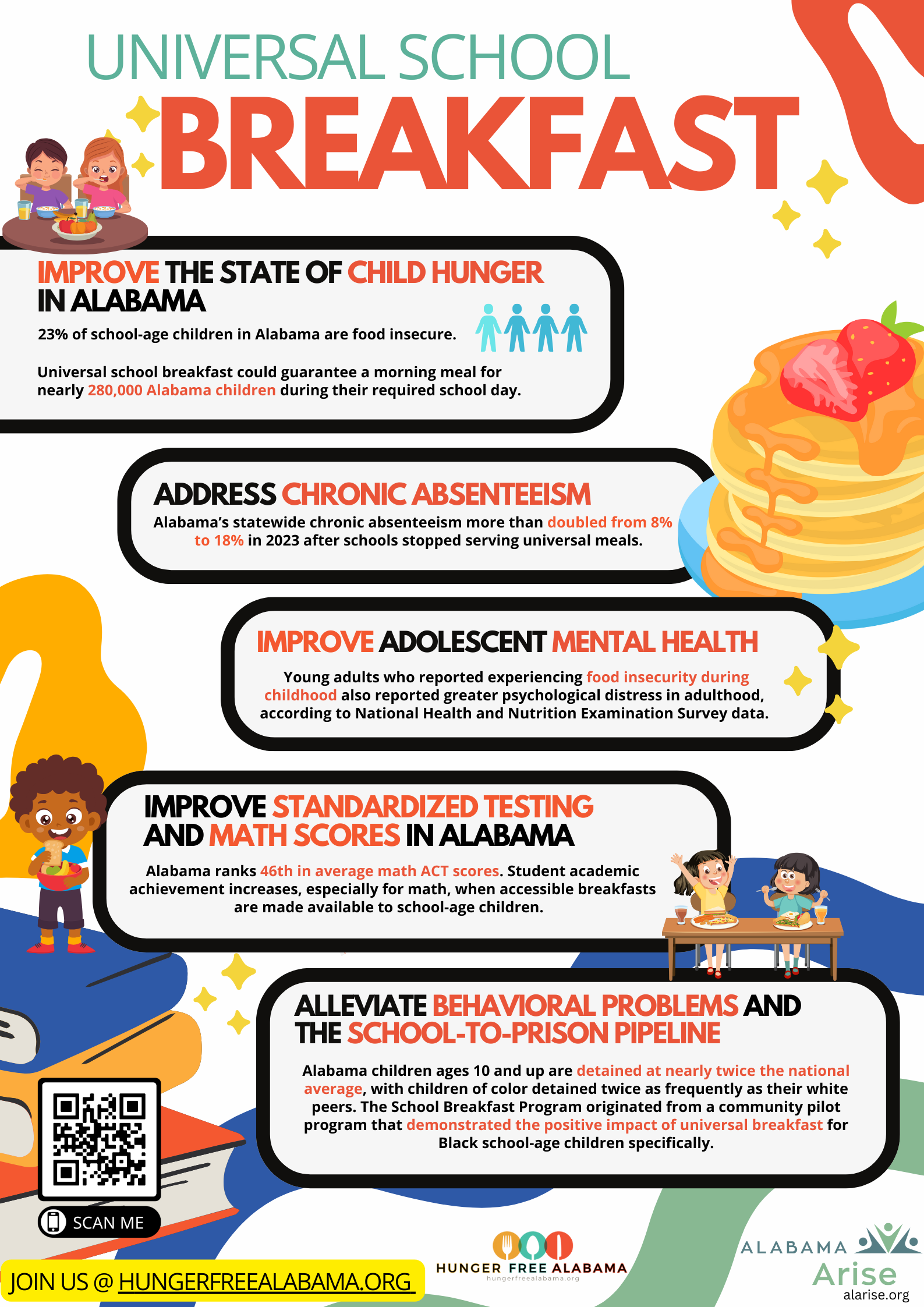
Universal school breakfast would benefit Alabama’s children in many ways


Universal school breakfast would:

Improve the state of child hunger in Alabama.

  • 23% of school-age children in Alabama are food insecure.
  • Universal school breakfast could guarantee a morning meal for nearly 280,000 Alabama children during their required school day.

Address chronic absenteeism.

  • Alabama’s statewide chronic absenteeism more than doubled from 8% to 18% in 2023 after schools stopped serving universal school meals.

Improve adolescent mental health.

  • Young adults who reported experiencing food insecurity during childhood also reported greater psychological distress in adulthood, according to National Health and Nutrition Examination Survey data.

Improve standardized testing and math scores in Alabama.

  • Alabama ranks 46th in average math ACT scores.
  • Student academic achievement increases, especially for math, when accessible breakfasts are made available to school-age children.

Alleviate behavioral problems and the school-to-prison pipeline.

  • Alabama children ages 10 and up are detained at nearly twice the national average, with children of color detained twice as frequently as their white peers.
  • The School Breakfast Program originated from a community pilot program that demonstrated the positive impact of universal breakfast for Black school-age children specifically.