The COVID-19 pandemic added to the hunger challenges already facing many Alabamians. In response came a wave of federal flexibilities and waivers for the nation’s programs that feed children. As a result, many Alabama students have received nutritious, often free meals with fewer administrative barriers.
However, many of these child nutrition waivers could be coming to an end soon ‒ unless state officials and concerned Alabamians act quickly.
For the past two summers, the Summer Food Service Program’s flexibilities have included permitting non-congregate meal service. This allows parents, guardians or children to take meals from the pickup site. It also allows meal provision for multiple days at once.
But unless the Alabama State Department of Education requests an extension, these flexibilities will end June 30. That would be in the middle of summer food service, causing undue stress and confusion to students, educators and families. Alabama Arise and other partners in the Hunger-Free Alabama coalition sent a letter to state school Superintendent Eric Mackey urging him to ask the U.S. Department of Agriculture for an extension for the rest of summer.
Above: Arise’s Celida Soto Garcia explains how community eligibility helps keep Alabama children fed.
The continued push for community eligibility
As we continue pushing for extended flexibility, it is important to keep building support for the Community Eligibility Provision (CEP). This option allows more than 450 high-poverty schools across Alabama to offer breakfast and lunch at no charge to all students. Arise members should contact their local school superintendents and urge them to opt into CEP if they haven’t already. Parents and guardians can take an extra step by submitting their school meal application to the appropriate school district.
Food insecurity is a challenge for 16.1% of Alabamians, including 20.4% of Alabama’s children, according to 2021 projections from Feeding America. These numbers are unacceptable and should not increase further because of preventable deadlines. Arise will continue to work proactively with local, state and national partners to expand food access across the state.
The Summer Food Service Program has been a critical tool to fight child hunger during the COVID-19 pandemic. But many key program flexibilities will expire June 30 unless Alabama applies for a waiver. Alabama Arise and our partners in the Hunger-Free Alabama coalition wrote a letter Thursday to state school Superintendent Eric Mackey to urge him to request federal permission to continue uninterrupted program service throughout the summer:
Letter text
Dear Dr. Mackey,
Alabama Arise appreciates the Alabama State Department of Education’s (ALSDE) commitment to ensuring that Alabama’s children receive the meals they need to learn and thrive, especially during these last few difficult pandemic years. As you know, access to nutritious meals is key to our children’s ability to learn and succeed in school and in life. Nowhere is that access more important than in our schools, both during the school year and during the summer, when childhood hunger often increases.
The U.S. Department of Agriculture (USDA) recently informed state Summer Food Service Program (SFSP) administrators, including the ALSDE, that some program flexibilities, scheduled to expire on June 30, could now be continued for the entire summer if the state requests to do so. These flexibilities include:
Permitting non-congregate meal service, which allows parents, guardians or children to take meals from the pickup site and allows meal provision for multiple days at once;
Allowing parents or guardians to pick up meals for their children; and
Allowing state flexibility in program monitoring.
Alabama Arise, our 150 member groups and more than 20 partners in the Hunger-Free Alabama coalition believe these flexibilities are critical for the 2022 Summer Food Service Program. We strongly encourage you to take advantage of, and apply for, these waivers.
The June 30 end of the original waivers would happen right in the middle of summer food service. This could not be more problematic for both families and providers. Changing food service operations, including the reimposition of on-site food consumption, would disrupt families’ work and child care arrangements and would require that providers completely alter how they feed children in midstream. Providers would have to try to communicate these changes, and the reason for them, adequately to children and their parents. We expect this would result in considerable confusion and frustration. For exactly these reasons, many SFSP providers already have decided to discontinue operations on July 1 if this waiver is not extended. Others, unfortunately, may not participate in the program at all this summer.
We know the hunger crisis caused by the pandemic and its economic disruption has not ended yet. The latest Census Household Pulse Survey (March 30-April 11) found that 15% of responding families with children said they sometimes or often did not have enough to eat. Of those families with children identified by the Census Bureau as food insecure, 25% said their children sometimes or often were not eating enough because food was unaffordable. School meals and the SFSP are critical for these families and their children.
The SFSP waivers have been important during the pandemic, addressing health concerns, supply chain disruptions and community program disruptions caused by the health crisis and economic challenges. Keeping these flexibilities in place for the remainder of the summer will help feed children and help summer meal sites operate safely and efficiently. We urge you to apply for these waivers as quickly as possible, knowing that time is of the essence as providers and families complete their summer planning process.
We appreciate your attention and your continued concern for the needs of our children. And we look forward to working with you to continue to feed Alabama’s schoolchildren this summer and into the future.
Arise’s Celida Soto Garcia explains how the Community Eligibility Provision (CEP) helps more than 450 high-poverty schools across Alabama offer breakfast and lunch to students at no charge. Now is the time to contact school superintendents and urge them to opt into CEP if their districts are eligible to participate.
A full transcript can be found below the video.
Hi. My name is Celida Soto Garcia, hunger policy advocate with Alabama Arise. Today I hope to share a few steps to make sure that children and families have ample food nutrition options this summer and during the upcoming school year.
I would also like to encourage parents and school administrators to join me in promoting the Community Eligibility Provision as dependable food and nutrition source during really uncertain times.
Community Eligibility Provision, or CEP for short, is a federal program that allows more than 450 high-poverty schools across Alabama to offer breakfast and lunch at no charge to all students. CEP reduces paperwork for schools so they can focus on providing healthy meals to help students learn and thrive.
CEP increases school meal participation by removing stigmas that are typically associated with having to pay for lunch and possibly not having the funds to do so that day. It maximizes federal reimbursement to schools with the highest rates of attending students living in low-income households.
CEP eliminates unpaid school meal fees and makes it easier to implement innovative service models such as breakfast in the classroom or some hearty snacks throughout the day.
Most notably, CEP saved the day in the early stages of the pandemic. When not participating, schools have to grapple with determining eligibility criteria before serving meals to families in need throughout the pandemic. Schools that had opted into CEP were best prepared to consistently meet food and nutrition needs. When so much more was uncertain for CEP schools, addressing hunger was a no-brainer, and school meals were made available to every child in need.
The pandemic taught us many lessons. Most notably, we learned that reliable sources of food and nutrition are vital to extending a sense of support and stability to communities. Temporary school meal waivers such as Seamless Summer Option, or SSO for short, and Summer Food Service Program, or SFP for short, strengthen the safety net during uncertain times. But these programs are ending soon. CEP offers a more dependable and enduring system for serving school meals to all children at no cost to families.
Also, students attending schools that opted into CEP were automatically eligible to receive Pandemic EBT. CEP facilitated feeding families during trying times, and it continues to be the most dependable support for ensuring all children receive the nutrition they need to survive and to thrive.
Now is the time to contact your local school superintendents and urge them to opt into the Community Eligibility Provision to secure a reliable source of food and nutrition for Alabama’s children.
Lastly, an urgent message to parents. Ending school meal waivers means that the parents and caregivers should ask your school administrator if your students school is adopting CEP in 2022-2023. If not, you will need to complete a school meal application for free or reduced-price meals as soon as possible. Thank you.
Feel free to submit any questions to info@HungerFreeAlabama.org or call 334-832-9060.
Listening is key to shaping and advancing public policies that matter most to those marginalized by bad policies. Alabama Arise depends on what we hear to help guide our work toward our vision of a better Alabama for all.
Our online Town Hall Tuesdays will return once again this year. These events are a chance to hear issue updates and share your vision for our 2023 priorities.
Please join us this summer to help identify emerging issues and inform our actions. Registration is required for any or all of the sessions. You can register at the link in each session below.
July 12th, 6 p.m. – Making the vision a reality: Food & health
Everyone should have access to food and the health care they need to live a long and healthy life. Join this session to discuss issue and advocacy opportunities in areas of access to food and health care. Click here to register for this session.
July 26th, 6 p.m. – Making the vision a reality: Democracy & justice
We envision a state where all government leaders are responsive, inclusive and justice-serving. Voting rights barriers and an unjust justice system have hindered our vision. But together, we can move forward. Join us to discuss how to improve voting access and advance criminal justice reforms. Click here to register for this session.
August 9th, 6 p.m. – Making the vision a reality: The path forward
Arise’s vision for Alabama can be realized because of our commitment and perseverance. We are committed to issues that matter to those marginalized by poverty, and we persevere in raising our voices together for change. Join this session to discuss issues already identified and to raise others. Click here to register for this session.
The Alabama Legislature’s 2022 regular session adjourned sine die late on Thursday, April 7. Lawmakers capped off the session’s last week with intense debates and late nights, with the final gavel dropping just before midnight.
Alabama Arise is grateful for the many positive outcomes that came out of the State House this year. We also were glad to play a role in stopping several misguided pieces of legislation from becoming law. These wins wouldn’t have been possible without the support of Arise’s determined members and various coalition partners.
We were not able to get every good bill across the finish line or stop every harmful legislative effort from happening. But Arise saw real progress on several important issue priorities this year. Keep reading below for recaps on some of the key bills we supported or opposed in 2022. Then visit our Bills of Interest page for updates on all of the legislation we tracked.
Adequate state budgets
Alabama’s fiscal year 2023 General Fund and Education Trust Fund budgets are both the largest in state history. The General Fund budget of $2.7 billion includes a provision to extend Medicaid postpartum coverage from 60 days to 12 months, which will help reduce maternal mortality and improve health outcomes for more than 30,000 women. Rep. Laura Hall, D-Huntsville, has been a longtime legislative champion for postpartum Medicaid extension.
The Education Trust Fund budget of $8.2 billion will provide a major boost in teacher pay. The increases will range from 4% all the way to 21% depending on seniority.
SB 140, sponsored by Sen. Del Marsh, R-Anniston, did not pass this session. The bill would have allowed the diversion of hundreds of millions of dollars from public schools to private schools. Arise opposed this effort.
SB 261, sponsored by Sen. Dan Roberts, R-Mountain Brook, passed out of both chambers. This bill will increase the income tax credit filers can claim for contributions to scholarship granting organizations for private schools. Arise opposed this effort.
Tax reform
HB 163 and SB 19, sponsored by Rep. Lynn Greer, R-Rogersville, and Sen. Arthur Orr, R-Decatur, passed out of both chambers. This legislation will increase the standard deduction and dependent exemption. That change will provide a small but significant income tax cut for low- and moderate-income Alabamians. Arise supported this effort.
SB 43, sponsored by Sen. Andrew Jones, R-Centre, did not pass this session. The bill would have repealed the state’s 4% grocery tax and capped the state deduction for federal income taxes. Despite strong bipartisan leadership from Jones and Rep. Penni McClammy, D-Montgomery, the bill did not come up for committee consideration. Arise supported this effort.
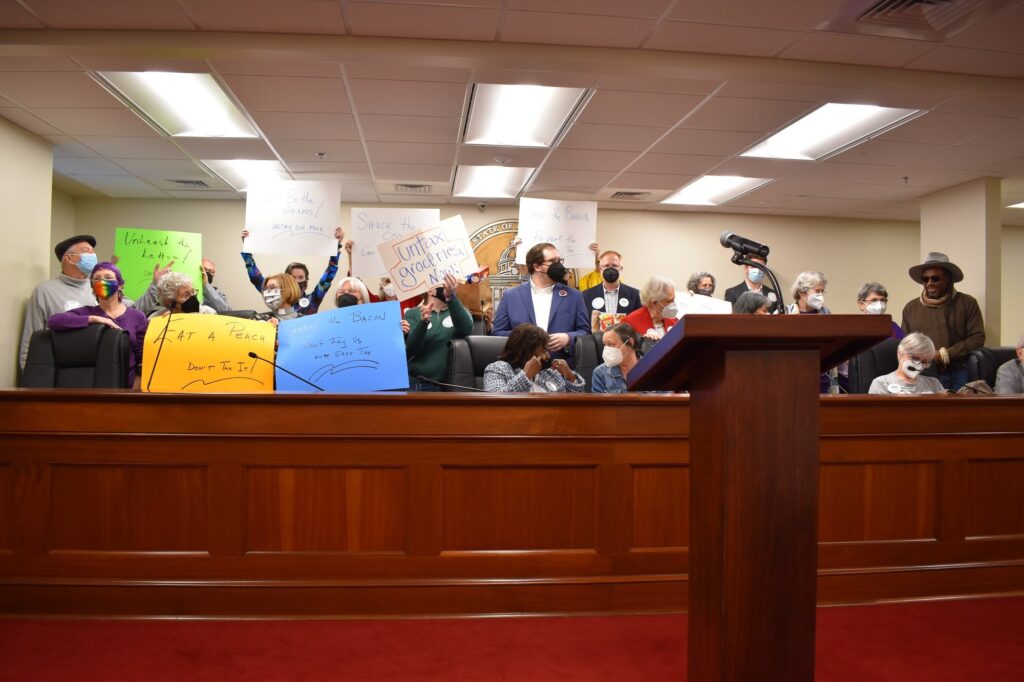
Alabama Arise members gathered for an Untax Groceries Rally at the State House in Montgomery on March 15, 2022. Bills to end the state grocery tax did not move in the Legislature this year, but the effort continues to enjoy growing bipartisan support.
Voting rights
HB 53 and SB 6, sponsored by Rep. Laura Hall, D-Huntsville, and Sen. Linda Coleman-Madison, D-Birmingham, passed the Senate but did not advance to the House floor. This bill would have eliminated application requirements for voting rights restoration. It also would have restored the right to vote for many indigent individuals. Arise supported this effort.
HB 63, sponsored by Rep. Debbie Wood, R-Valley, did not pass this session. The bill would have criminalized the prefilling of any voter application or absentee ballot application. Arise opposed this effort.
Hall’s HB 167 failed to pass this session. This legislation would allow inmate identification cards to be used as valid ID for voting. Arise supported this effort.
HB 194, introduced by Rep. Wes Allen, R-Troy, passed out of both chambers. The bill will prohibit state and local election officials from soliciting, accepting or using donations for election-related expenses. Arise opposed this effort.
Criminal justice reform
HB 52, sponsored by Rep. Jim Hill, R-Moody, passed out of both chambers. This bill will allow judges to use discretion in the length of someone’s sentence if their probation is revoked. Arise supported this effort.
HB 95, sponsored by Rep. Jeremy Gray, D-Opelika, passed out of both chambers. The bill will create a 180-day grace period for people to repay court-imposed fines and fees following release from incarceration. Arise supported this effort.
SB 203, sponsored by Sen. Arthur Orr, R-Decatur, passed out of both chambers. This bill will require the Administrative Office of Courts to establish a database of municipal fines and fees. Arise supported this effort.
HB 230, sponsored by Rep. Rolanda Hollis, D-Birmingham, passed out of both chambers. This bill will ban the routine shackling of incarcerated individuals during pregnancy, delivery and immediate postpartum time. Arise supported this effort.
HB 200 and SB 117, sponsored by Rep. Merika Coleman, D-Birmingham, and Sen. Will Barfoot, R-Montgomery, failed to pass this session. The bill would have ended driver’s license suspensions for failure to pay fines and fees. Arise supported this effort.
SB 220, sponsored by Sen. Linda Coleman-Madison, D-Birmingham, failed to pass this session. The bill would have required that time served awaiting a hearing for parole violation be applied retroactively. Arise supported this effort.
HB 2, sponsored by Rep. Allen Treadaway, R-Morris, did not pass this session. This anti-protest bill would have created minimum holding periods for people accused of the crimes of rioting or interfering with traffic. It also would have penalized certain local jurisdictions that reduce funding for law enforcement. Arise opposed this effort.
Hill’s HB 55 failed to pass this session. The bill would have required every judicial circuit to establish a community corrections program. Arise supported this effort.
Unemployment insurance benefits
SB 224, sponsored by Sen. Arthur Orr, R-Decatur, passed out of both chambers. This bill will impose additional job search requirements as a condition of eligibility for unemployment insurance benefits. Specifically, individuals will have to show a “reasonable and active effort” to find work by providing proof every week that they have contacted at least three prospective employers. Unless a new job notice has been posted, a job seeker cannot apply for or seek work at an employer where they already made contact. Arise opposed this effort.
Food security
SB 156, sponsored by Sen. Arthur Orr, R-Decatur, did not pass this session. The bill would have required both custodial and non-custodial parents to cooperate with child support enforcement to qualify for SNAP food assistance. Arise opposed this effort.
‘Divisive concepts’
HB 312 and SB 292, sponsored by Rep. Ed Oliver, R-Dadeville, and Sen. Will Barfoot, R-Montgomery, did not pass this session. The bill would have prohibited the teaching of “divisive concepts” related to race, religion and sex in public K-12 schools, colleges, universities and certain state training programs. Arise opposed this effort.
Arise’s Robyn Hyden breaks down successes and missed opportunities from the Alabama Legislature’s 2022 regular session, which ended Thursday night. She highlights breakthroughs on federal ARPA funds, postpartum Medicaid extension and criminal justice reform, among other issues.
Arise’s Celida Soto Garcia discusses the problems with SB 156, a bill that would deny SNAP food assistance to Alabamians who fail to “cooperate” or “comply” with child support orders or collection services. The bill could come up for a Senate vote this week. Celida also discusses Arise’s upcoming Untax Groceries Rally, scheduled for March 15 in Montgomery.
The Alabama Legislature’s 2022 regular session, which began Tuesday, will be unusual in one important way. For the first time in many years, Alabama has more than enough revenue to maintain its bare-bones public services. That means instead of scrambling to avoid cuts, the legislative focus can be on strengthening investments in our state’s future.
Both the Education Trust Fund (ETF) budget and the General Fund (GF) budget, which funds non-education programs, have seen tax revenues rise more than 10% in the last year. ETF revenues actually increased 16% in 2021. In addition, Alabama has about $1.6 billion of federal relief funds remaining under the American Rescue Plan Act (ARPA). President Joe Biden signed ARPA into law in March 2021.
Alabama lawmakers already allocated $480 million of the state’s ARPA money last year. Of that amount, $400 million went toward prison construction and $80 million went to hospitals and nursing homes.
Budget growth faces sustainability challenges
State budget officials have steadily cautioned lawmakers to consider the one-time nature of both relief money and the bump in tax revenues. Recent revenue growth almost certainly will not be sustained in future years, budget officials warn. And one-time ARPA funds are by definition only temporary.
Alabama’s budget officials have strongly recommended that both ARPA funds and increased state revenues be invested in programs and services that won’t require regular, recurring revenue but that still meet critical needs for the people of the state. Alabama Arise questions whether the new revenue is as unsustainable as budget officials predict. But Arise agrees that this money needs to fund big ideas that will benefit the state for years to come.
Areas for investment
If spent wisely, ARPA funds could create vital long-term improvements for Alabamians. Alabama Arise has numerous specific suggestions for what those big ideas, and investments, could be.
Serve underserved communities
ARPA investments should focus on the most underserved areas and most underserved Alabamians. Communities of color and communities with low incomes, particularly in the Black Belt, have long-festering unmet infrastructure needs. The lack of wastewater treatment, accessible broadband internet, affordable housing and public transportation has held these communities back for decades.
In deciding where to spend new one-time dollars, the most historically neglected parts of Alabama should come first. An urgent public health need in many rural Black Belt counties is for sewer and other water treatment systems. These should be a top priority.
Modernize state technology
A major lesson from the COVID-19 recession was that Alabama’s technology infrastructure is totally inadequate for remote access to services. Suddenly unemployed people desperately tried to apply for unemployment insurance (UI) benefits, food assistance, COVID-19 tests and other services on overwhelmed state computer and telephone systems. People who had never before applied for public assistance couldn’t find one-stop sources of information about services for which they might be eligible. And when new federal programs were created, they were hard to implement. That’s because Alabama’s computer systems didn’t talk to each other and couldn’t share information needed to help people get assistance.
Modernizing the state’s computer systems would be a great investment to increase efficiency and prepare us for the next crisis. This would allow for integrated eligibility and data sharing systems across state agencies. And it would be an opportunity to modernize and upgrade the state’s UI application and payment process.
Expand Medicaid and strengthen public health
Alabama has failed for decades to invest adequately in our health care infrastructure, including Medicaid. The devastating toll of the COVID-19 pandemic has made the consequences of that failure apparent to everyone in the state. We need to invest now in a health care infrastructure that will improve the delivery of health services to underserved individuals and communities.
Medicaid expansion to cover adults with low incomes is an essential step to strengthen Alabama’s health care system. Other investments should include more funding for mobile health services and telehealth services. Alabama also should provide additional resources for our local and state public health departments.
Reduce hunger and promote healthier communities
Hunger was already a large and perpetual problem across Alabama even before the pandemic. But the COVID-19 recession and its aftermath exacerbated this problem by fueling a rapid, major increase in food insecurity. Sudden income loss, rising prices and occasional shortages have made it much more difficult for many people to feed their children and families.
The Supplemental Nutrition Assistance Program (SNAP) and various child nutrition programs are essential standing resources to fight hunger in Alabama. But the state can and should do more to support our food infrastructure. Alabama should provide healthy food financing grants to expand community groceries, farmers markets and mobile markets. This would improve access to healthy foods in communities without ready access to fresh foods, especially fruits and vegetables.
Invest in affordable housing
The COVID-19 recession has caused a wave of evictions and foreclosures across Alabama. This has occurred as the cost of housing has been driven up amid supply chain issues and fewer available workers.
Alabama could help address its housing shortage and resulting homelessness by providing $25 million for the state Housing Trust Fund. This investment would create and support jobs across the state. And it would reduce Alabama’s shortfall of more than 73,000 affordable homes for people with incomes below the federal poverty level.
Fund public transportation
Alabama’s elected leaders, including Gov. Kay Ivey in her State of the State address, have celebrated the state’s low unemployment rate. But they also are bemoaning our state’s associated low rate of labor force participation. For more Alabamians to return to work during and after the pandemic, the state must ensure they have essential work supports. Not the least of these is transportation to and from a job or school.
Lawmakers can help people reenter the job market by investing $20 million in ARPA funds and $10 million in GF dollars in the state Public Transportation Trust Fund. These dollars would go a long way toward ensuring that people, especially those in rural areas, can get to a job and to job training. They also would help Alabama match other federal transportation dollars that can benefit the entire state.
Unlike legislative advocacy, administrative advocacy is an aspect of Alabama Arise’s work we don’t talk about often. Yet that’s where some of our biggest policy wins happen.
State agencies and leaders can accomplish some important policy changes via rule changes. Sometimes legislators pass policies with good intentions, but administrative barriers and red tape stop them from being fully effective. Our members and constituents often help identify barriers to remove.
Given the nature of Alabama politics, it’s strategically important at times to keep some changes under the radar. But in recent years, administrative action has led to big steps forward on some top Arise priorities:
Streamlining the process to access Medicaid, SNAP food assistance and TANF income assistance.
Creating more openings for Medicaid home- and community-based long-term care services.
Expanding the emergency flexibility of Medicaid and SNAP to respond to the COVID-19 pandemic via emergency waivers, and expanding the types of support available to TANF participants.
As we see new opportunities to expand and shore up the social safety net this year, a portion of our policy advocacy work will continue to be this type of behind-the-scenes administrative analysis and advocacy.
One example we’re working on now: pushing the Alabama Housing Finance Authority to distribute federal rental assistance more quickly. We’re also working with local advocates to streamline how city and county aid gets out into communities.
If you see a way programs aren’t being implemented effectively in your community, let us know! We’re continuing to expand our ability to track and support this type of advocacy. And we’re looking for new ways to engage more directly impacted people in our feedback to state agencies and decision-makers.
It’s Labor Day weekend. The days are ever so slightly cooler. Football season has started. And Alabama’s economy is officially “open for business.” So why are so many jobs still going unfilled in our state? Why are employers looking for workers and not finding them?
A look at some very interesting data can provide a few answers.
Unemployment vs labor force
Alabama’s unemployment rate is one of the lowest in the nation, a very impressive 3.2% in July. But another number doesn’t get as much attention as the unemployment rate: the labor force participation rate. Labor force participation is the number of people who are either working or looking for work divided by the total number of working-age, non-institutionalized people in the state.
Alabama’s labor force participation rate is one of the nation’s lowest. That means many people here are neither working nor looking for work. And that low number may tell us about why a lot of available jobs are not being filled.
In 2008, Alabama’s labor force participation rate was 60.6%. That means 60.6% of potential workers were either employed or looking for employment. By July 2021, our labor force participation rate had declined to 48th nationally at 56.7%. Alabama is also 44th nationally in the share of our adult population who are employed ‒ only slightly under 55%.
Barriers to work
We all know how hard-working the people of Alabama are. We pride ourselves on our work ethic, independence and resilience. But many Alabamians face significant barriers to employment that the pandemic has exacerbated. And those structural barriers have left many jobs unfilled while potential employees are unable to work.
One important explanation revolves around child care. In the recent study, “Where Are They Now? Workers with Young Children during COVID-19,” M. Melinda Pitts of the Federal Reserve Bank of Atlanta found that the workforce exits of women with children under age 13 accounted for much of the decline in employment. And she attributed much of this decline to the unavailability of quality child care during the pandemic and continued unwillingness to use child care services with the virus still raging. Even with schools and child care centers reopening, Pitts concluded, the continued risk of COVID-19, low vaccination rates and uncertainty about school closures would continue to depress employment rates among women with young children.
Pandemic’s effects
Every couple of weeks during the pandemic, the U.S. Census Bureau has conducted a survey in every state called the Household Pulse Survey. This survey asks a sample of people about how the pandemic has affected their lives, from food security to employment and income. The most recent results from Alabama, for the weeks of Aug. 4-16, provide meaningful insight into why Alabamians may not be taking advantage of the supposedly booming job market. (Arise calculated the following percentages based on survey results.)
Alabama findings
Despite the low unemployment rate, many Alabamians, especially women, are not yet employed. Among Alabama women who responded to the survey, 47% were not employed in the seven days preceding the survey, compared to slightly more than 37% of men who were not working.
When asked why they were not working, nearly 12% of Alabamians who are not retired and do not have a disability said they were caring for children not in school or day care. Another 5% said they were caring for an older adult.
About 5% of Alabama respondents who are not retired and don’t have a disability said they weren’t working because they were afraid of getting COVID-19.
More than 11% of Alabamians who are not retired and don’t have a disability said they had lost their job because of the pandemic.
About 4% of Alabama respondents who are not retired and don’t have a disability said they weren’t working because they didn’t have transportation to work.
The Household Pulse Survey doesn’t break out non-employment rates for men and women by race. But it does show non-employment rates are higher in general for Black people (nearly 49%) and Hispanic/Latinx people (46%) than for white people (40%). Whether because of COVID-19’s impacts or employment barriers or both, people of color are disproportionately affected. This is consistent with research by the Economic Policy Institute which found that Black Alabamians had a 2021 unemployment rate 40% higher than did White Alabamians.
Alabama businesses are desperately looking for workers, and Alabamians want to return to work. But for this to happen, our leadership needs to support workers instead of blaming essential income supports or the workers themselves for vacant jobs. What should elected officials do?
Recommendations:
Wages
Many of the jobs that remain unfilled are in the service sector. These are the public-facing jobs filled by people we hailed as “essential workers” last year. People essential to our recovery from the pandemic and its recession need a living wage. They also need employment supports like health insurance, paid time off and protections from potential coronavirus infection so they can return to work and still take care of their children and families.
Child care
Congress has appropriated significant funds to support child care centers and the parents who need them. And the Department of Human Resources has done a good job of targeting money where it most needs to go. But the number of respondents listing child care or senior care as the reason they are not able to work indicates even more needs to be done. Alabama should redouble its efforts to ensure safe, affordable child care and senior care are available when people need to work, including evenings and weekends.
Public transportation
Alabama lacks public transportation in all but our biggest cities. Even there, transit is limited and often doesn’t get people to the jobs available to them. If Congress approves new infrastructure funds, Alabama should invest heavily in public transportation in both urban and rural counties. These investments would help residents get to work, school, the doctor’s office and other essential locations.
Unemployment insurance benefits
More than 11% of Alabama Household Pulse respondents say they have lost jobs due to the pandemic. That may result from their employer laying them off, going out of business or closing temporarily. People unemployed because of the pandemic continue to need unemployment income (UI) benefits. Alabama’s unemployment compensation system unfortunately has failed to respond adequately either during the recession’s height or our slow recovery. The decision to reduce UI benefits in an effort to force workers back into jobs has only increased suffering without filling the vacant jobs. Alabama needs to invest in a robust unemployment compensation infrastructure. The state also needs to bolster benefits for laid-off workers still suffering the pandemic’s effects.
Health care
Nearly 9% of all the people who responded to the Household Pulse Survey in early August said they were not working because of disability or health problems. Adequate, accessible and affordable health care services can help people address health problems that make work difficult or impossible. Alabama must expand Medicaid to provide these health services if we want to jump-start our economy fully.
Public transparency
The Alabama Department of Labor should return to its former practice of releasing unemployment data via news releases. Months after cutting off the $300 federal supplement, UI claims remain at 297% of pre-pandemic claim numbers. This data shows that, contrary to the false narrative pushed by some officials, pandemic unemployment has never been a result of the increased benefits available through federal assistance. The state should return to publicly acknowledging the data that lays out recent policy mistakes and the number of Alabamians harmed by anti-worker decisions.
COVID-19 concerns
Finally, 5% of Household Pulse respondents who are not retired and do not have a disability said they had not reentered the workforce because of very realistic fears of COVID-19. Alabama and the nation need to ensure our investments in public health interventions and COVID-19 mitigation are science-based and effective. That includes efforts to address vaccine hesitancy and misinformation in Alabama.

 ARPA investments should focus on the most underserved areas and most underserved Alabamians. Communities of color and communities with low incomes, particularly in the Black Belt, have
  A major lesson from the COVID-19 recession was that Alabama’s technology infrastructure is totally inadequate for remote access to services. Suddenly unemployed people desperately tried to apply for unemployment insurance (UI) benefits, food assistance, COVID-19 tests and other services on overwhelmed state computer and telephone systems. People who had never before applied for public assistance couldn’t find one-stop sources of information about services for which they might be eligible. And when new federal programs were created, they were hard to implement. That’s because Alabama’s computer systems didn’t talk to each other and couldn’t share information needed to help people get assistance.
 Alabama has failed for decades to invest adequately in our health care infrastructure, including Medicaid. The devastating toll of the COVID-19 pandemic has made the consequences of that failure apparent to everyone in the state. We need to invest now in a health care infrastructure that will improve the delivery of health services to underserved individuals and communities.
 Hunger was already a large and perpetual problem across Alabama even before the pandemic. But the COVID-19 recession and its aftermath
  The COVID-19 recession has caused a wave of evictions and foreclosures across Alabama. This has occurred as the cost of housing has been driven up amid supply chain issues and fewer available workers.
 Alabama’s elected leaders, including Gov. Kay Ivey in her State of the State address, have celebrated the state’s low unemployment rate. But they also are bemoaning our state’s associated low rate of labor force participation. For more Alabamians to return to work during and after the pandemic, the state must ensure they have essential work supports. Not the least of these is transportation to and from a job or school.