School breakfast helps kids learn: Children who start the day with breakfast learn better. They have better classroom participation and are less likely to skip school than kids who don’t get breakfast. But tight family budgets and stressful mornings mean many children arrive at school hungry. School breakfast can help fill this gap.
School, bus and family schedules make it difficult to serve breakfast before the school day begins: School breakfast participation declined nearly 8% nationally after pandemic-era free breakfast ended. Only half of the children who get lunch at school also get breakfast.
The solution – universal free breakfast: School districts across the country have found that breakfast served after the first bell increases participation and helps kids learn.
Paperwork is a barrier for hungry children: Federal funding for traditional school breakfast relies on school’s assessing students’ eligibility for meal subsidies and reporting on how many free, reduced and paid meals are served. The Community Eligibility Provision (CEP) can reduce the paperwork for schools that serve a high share of children with low incomes. But many schools either can’t make CEP work financially or worry about its impact on other federal grants.
What the Legislature can do: The Legislature can help feed Alabama’s schoolchildren by appropriating Education Trust Fund (ETF) money to match federal reduced and paid breakfast funds. Schools that want to offer free breakfast can use these matching funds to provide breakfast for all of their students at the start of the school day.
How this would work: The Legislature would appropriate money to match federal school breakfast grants. The Alabama State Department of Education would allow local schools to apply and would distribute these matching dollars. Schools that receive funding would report to, and be monitored by, the Department of Education.
The decision to offer free breakfast is optional: Whether to apply for matching funds would be totally voluntary for schools or systems. Those that want to participate can apply for the matching funds. Those that don’t think it will work for them can choose not to apply.
How this would interact with CEP: The Community Eligibility Provision allows eligible schools to provide free meals for all their students. But some Alabama schools that are technically eligible for CEP can’t make the federal reimbursement rate work for them. And other Alabama schools would like to offer free breakfast but don’t want to adopt CEP fully. This proposal would allow schools to be made whole if they do adopt CEP or would allow schools to offer universal breakfast without having to adopt CEP fully.
Bottom line
An ETF appropriation of approximately $14 million in 2023 dollars would allow every school in Alabama to offer breakfast to all of their students.
Many Alabamians think of public education as a natural part of growing up and of community life. Public schools are at the center of hundreds of communities across our state. And their calendars often set a rhythm for the flow of the year: football games in the fall, band concerts and theater productions in the winter, proms in the spring and graduation ceremonies in May.
So it might surprise most Alabamians to know the Alabama Constitution – our foundational document – does not guarantee our children a right to public education. And despite our pride in our local schools, Alabama historically has failed to fund those schools adequately.
Thirty-nine states and the District of Columbia spend more in state and local funds per student than Alabama. And despite legislative boasts that Alabama education budgets have hit record high, our state funding for K-12 schools since 2009 has failed to keep up with inflation.
Now a new law will make that underinvestment even worse. Alabama’s public schools took a big funding hit in 2024 when the Legislature passed the Creating Hope and Opportunity for our Students’ Education (CHOOSE) Act. The CHOOSE Act will give parents a refundable tax credit of up to $7,000 per child for private school or homeschooling. Parents will be eligible for the credit regardless of whether their child has ever been enrolled in a public school. And in a few years, every parent in Alabama will be eligible, no matter how high their income may be.
Because the tax credit is refundable, parents can receive more money for private school tuition than they actually paid in taxes. The money for these “education savings accounts” – essentially school vouchers by another name – will come from sales and income tax revenues that otherwise would go to Alabama’s public schools under the Education Trust Fund (ETF).
How the CHOOSE Act became law
Lawmakers laid the foundation for the CHOOSE Act in 2013 when they hurriedly passed the Alabama Accountability Act (AAA). That law created a limited number of tax credits to subsidize private school tuition, with priority given to parents of children zoned for so-called “failing schools.” Many of these schools serve disproportionate shares of Black and Hispanic students and are located in communities with high poverty rates and a history of state underinvestment. The AAA also gave tax breaks for donations to some groups that give scholarships to pay for private school tuition. State law caps the total amount of AAA tax credits at $40 million annually, with flexibility for that amount to increase to $60 million eventually.
The CHOOSE Act will cost much more, and it is part of a broader nationwide legislative push by conservative activists. More than a dozen states have passed school voucher bills, spurred by ideology rooted in hostility to public education and a misplaced belief that competition improves education. Vouchers for private education are also a key recommendation in the Heritage Foundation’s Project 2025.
In her 2024 State of the State address, Gov. Kay Ivey said, “Passing an education savings account bill … is my number one priority.” The Legislature responded by passing the CHOOSE Act early in the session. Alabama Arise testified against the legislation in both House and Senate committee hearings, but lawmakers fast-tracked the bill to Ivey. She signed it into law in March 2024.
Tax credits eventually will go to all families, regardless of income
Even the wealthiest Alabamians will qualify for CHOOSE Act tax credits – and even if their children never attended public school. Beginning in the 2025 school year, eligibility for education savings accounts under the act will extend to families with incomes below 300% of the federal poverty level (approximately $77,460 for a family of three in 2024). But beginning in the 2027 school year, there will be no income limits to receive the taxpayer funds for private school.
Children who have special needs, whose parents are active duty service members, or whose siblings already receive a tax credit will have priority. But the law does not require that participating families ever have sent a child to public school. So parents who are already paying private school tuition will become eligible for taxpayer subsidies for their existing private school enrollment.
And because the act places no limit on how many families can get tax credits, almost every applicant will be eligible – with one exception. Undocumented parents and their children are ineligible for the tax credits. Even if the children are American citizens, and even if the parents are paying state, local and federal taxes.
The only limit on the CHOOSE Act’s cost is how much money the Legislature is willing to spend on it. The law requires lawmakers to allocate at least $100 million a year for tax credits under the plan. But without a cap on the overall amount of CHOOSE Act credits, legislators quickly could face enormous pressure to divert much more ETF money away from public schools.
Concerns about a lack of oversight
Schools that receive taxpayer subsidies under the CHOOSE Act will have relatively little public oversight. The act requires much less accountability from private schools than is required from Alabama’s public schools.
Schools that receive funds from education savings accounts are prohibited from discrimination based on race, color or national origin. But the law is silent on their ability to discriminate on the basis of gender, gender identity, sexual orientation or disability status. And while the act names children with special needs as priorities for education savings accounts, private schools – unlike public schools – have no obligation to admit children with special needs.
Schools that receive CHOOSE Act subsidies must be accredited. But a wide list of potential accreditation agencies exists, and the law provides no guarantee that a child will receive an education equivalent to that provided by public schools. Similarly, a standardized assessment of student progress is required, but the assessment now required for public school students is not required for private school students using education savings accounts.
Schools that receive funds under the CHOOSE Act are specifically allowed complete autonomy in designing their curriculum, including religious instruction. And the act does not explicitly forbid these schools to discriminate based on religion in employment and admission policies.
The CHOOSE Act will take money out of public schools
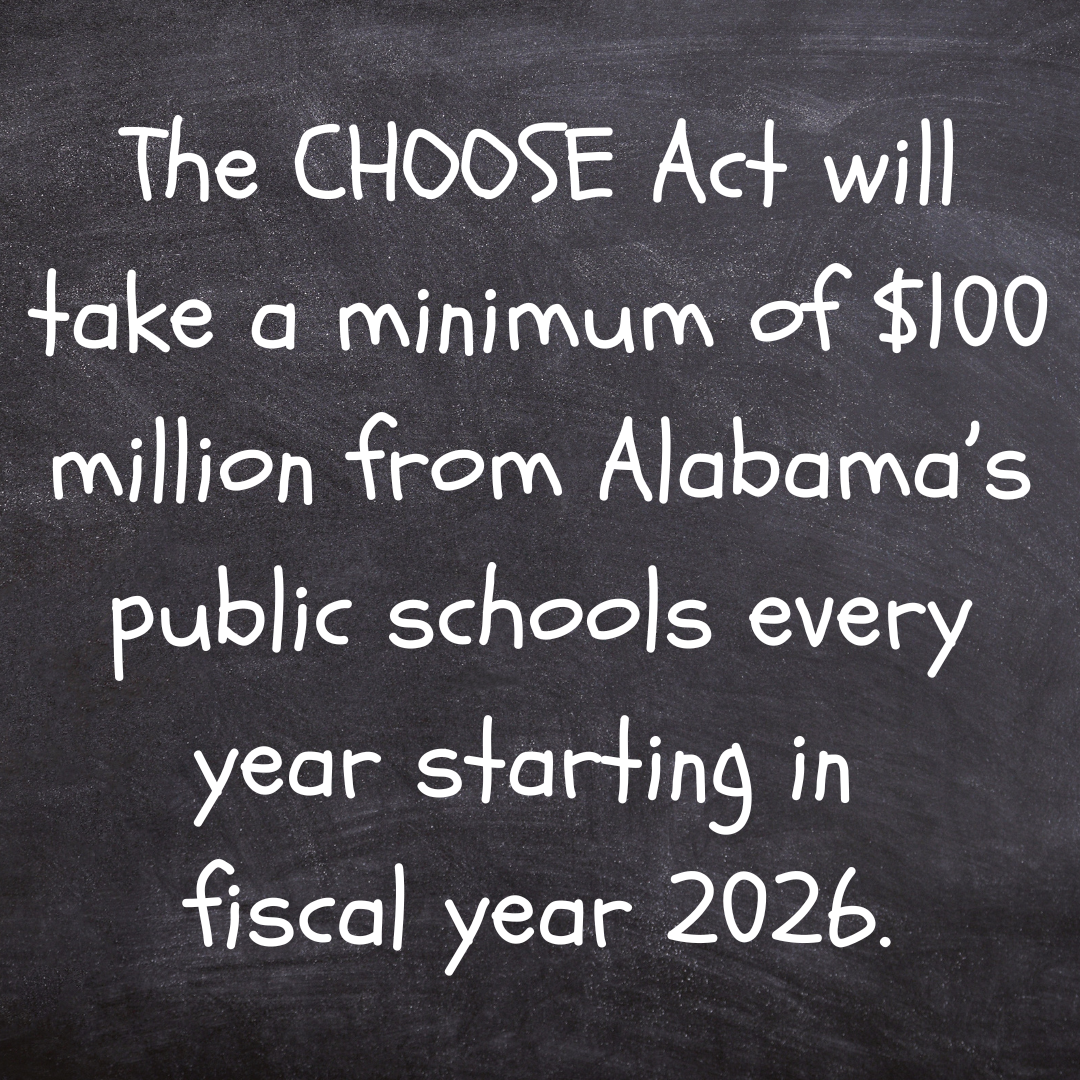
The CHOOSE Act will take a minimum of $100 million from Alabama’s public schools every year starting in fiscal year 2026. This would be a devastating financial blow for underfunded K-12 schools across our state.
That’s bad enough. But things could get much worse: The law does not cap how much can be spent on education savings accounts. And the CHOOSE Act specifically states legislators’ intent to increase expenditures whenever the demand for tax credits exceeds 90% of the allocated funds in the prior year. As accountants across Alabama begin urging their clients to pursue tax credits to help cover the cost of their children’s private school tuition, lawmakers could face intense pressure to allocate significantly more for education savings accounts.
If the takeup of these accounts is high enough, the CHOOSE Act could drain hundreds of millions of dollars each year from the ETF budget and from our public schools. That could lead to larger class sizes and less money for textbooks, technology, school maintenance and other investments in Alabama children’s educational success.
This gutting of money from public schools has played out in other states that have adopted similar programs. In Arizona, education savings accounts were forecast to cost $33 million in the first year and $65 million in the second. Actual costs were more than 10 times higher: nearly $600 million in the first year and more than $700 million in the second. In New Hampshire, costs exploded from an estimate of $300,000 in the first year to more than $8 million in the first year to $25 million in the third.
School ‘choice’ doesn’t improve student achievement
Studies of school achievement have shown that public support of private education doesn’t necessarily lead to higher student achievement or better test scores. Instead, increases in school funding, especially dollars targeted to children with the greatest needs, do improve test scores, graduation rates and post-graduation wages.
The Alabama Legislature is studying the formula by which our state funds public education, with an eye toward increasing equity and opportunity. Any diversion of money to private schools only hurts our efforts to achieve more equitable funding for public schools.
Bottom line
Alabama needs to invest in high-quality public schools focused on meeting the needs of children who live in poverty or face other educational barriers. And our state needs to reject efforts to divert public education dollars to subsidize wealthy households and benefit unaccountable private schools. The CHOOSE Act was the wrong choice for Alabama families, and lawmakers should either drastically reform it or repeal it.
Workers’ rights are human rights. Labor unions uplift workers and our communities. When we work together, we can have a louder voice in Montgomery for working-class Alabamians. Working together, we can fight for an Alabama where all people have resources and opportunities to reach their potential to live happy, productive lives!
Alabama Arise is a statewide, member-led nonprofit organization advancing public policies to improve the lives of Alabamians who are marginalized by poverty. Our membership includes faith-based, community, nonprofit and civic groups, labor, grassroots leaders and individuals from across Alabama. Our members select our annual legislative agenda, focusing on the issues that matter most to alleviate poverty and its effects.
How you can help
Your organization (such as local unions, labor councils, churches, retiree chapters, etc.) can join as a member group. You also can join as an individual with a donation of any amount. Follow us on social media and sign up for our email list. Invite us to speak at your meeting. And spread the word to your friends, family, coworkers and the rest of your network!
Why join Arise
Member groups can propose issues for our legislative agenda and choose delegates to vote. Delegates and individual members then vote on our legislative priorities, which are presented at our Annual Meeting each fall. As members, you’ll stay in the loop with our Daily News Digest, legislative updates, newsletters and more. And by joining our coalition, you’ll be amplifying our shared voice as we fight for working people!
How Arise supports worker power
Fighting to toughen, rather than weaken, child labor laws
Fighting for fully and equitably funded public schools and against voucher/privatization schemes
Working to reduce poverty by advocating for adequate state budgets, tax reform, Medicaid expansion, public transportation, criminal justice reform and more
Join ATU 770, Central Alabama Labor Federation, Jobs to Move America, North Alabama Area Labor Council and the rest of our growing coalition at Alabama Arise!
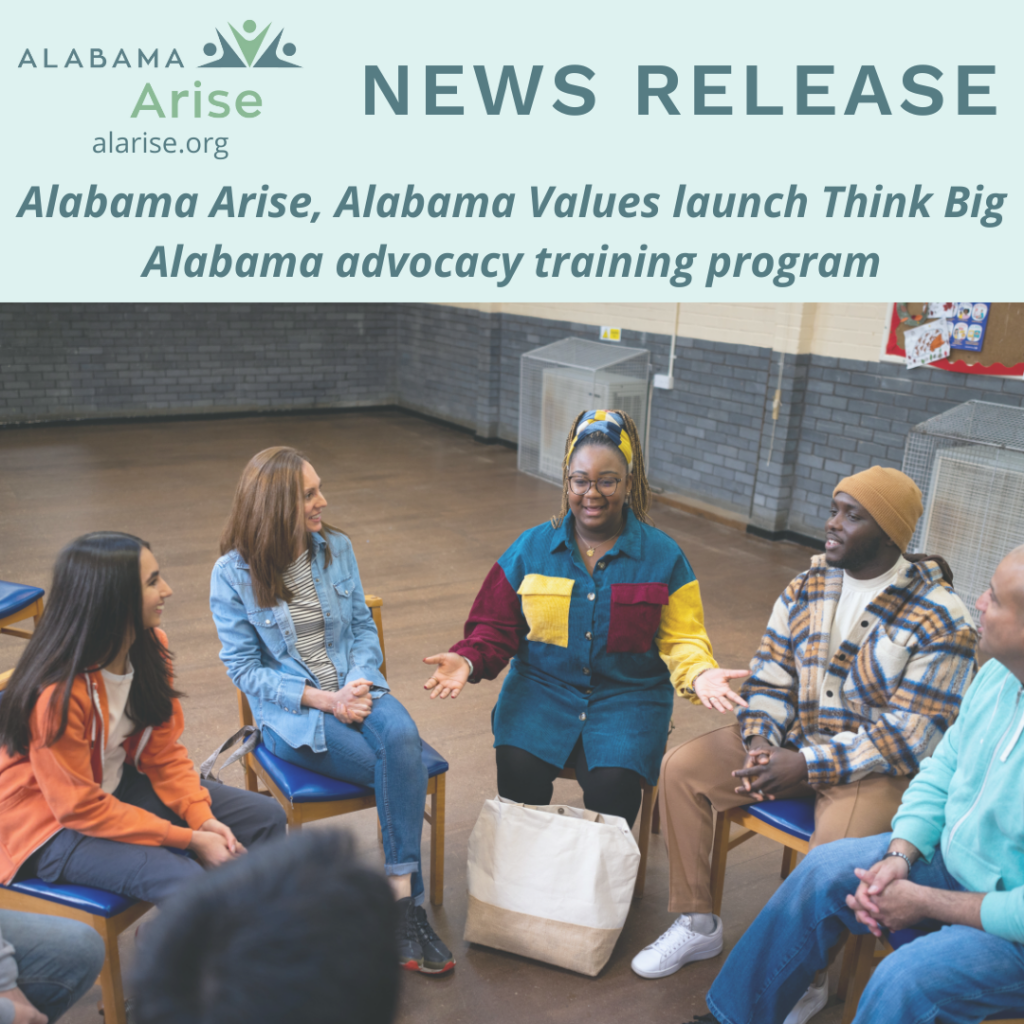
Alabama Arise and Alabama Values announce the launch of Think Big Alabama: Empowering Voices for Change, a four-part advocacy training program aimed at empowering underserved and underrepresented communities in Alabama. The program, running from July 13 to Aug. 24, will equip 20 participants with essential skills in media, public policy and grassroots organizing. BIPOC Alabamians are encouraged to apply.
The Think Big Alabama program is designed to align with the missions of Alabama Arise and Alabama Values, focusing on empowering communities by providing the knowledge, skills and tools necessary to address pressing issues impacting their lives. This program will transform research findings from the Think Big learning community into actionable steps for advocacy and change.
“Through this collaboration, we are demystifying the legislative process and providing essential advocacy skills to people who want to improve their communities’ well-being and make Alabama a better, more inclusive place for everyone,” said Presdelane Harris, organizing director of Alabama Arise. “Our goal is to engage Alabamians to become active participants in shaping the policies that affect their lives.”
Alabama Arise is a statewide, member-led organization advancing public policies to improve the lives of Alabamians marginalized by poverty. The organization’s dedication to policy advocacy and community engagement makes it a key partner in this transformative program.
Participants will engage in both in-person and virtual sessions, immersing themselves in a comprehensive curriculum that covers narrative building, grassroots organizing, policy advocacy and media strategies. The program will begin with foundational insights into the intersection of media, policy and grassroots organizing, fostering an environment of collaboration and community engagement.
‘More than a training program’
Alabama Values will bring to the program its expertise in narrative and messaging for social change, helping participants craft compelling stories that resonate and drive action. Alabama Arise will contribute its deep knowledge of policy advocacy and grassroots organizing, providing participants with practical tools and strategies to navigate the legislative landscape and advocate for meaningful policy changes. Together, these organizations will create a dynamic and supportive learning environment where participants can thrive and become powerful advocates for their communities.
Sessions will cover place-based storytelling, crafting compelling narratives and utilizing media platforms for advocacy. Participants also will learn effective grassroots organizing strategies and helpful policy narratives, with practical skills and strategies provided by Alabama Arise. The program will conclude with participants finalizing individual or group action plans to address specific state or local issues, equipping them with long-term engagement strategies for ongoing community involvement and impact.
“Think Big Alabama is more than a training program; it’s a movement to empower marginalized communities and amplify their voices in public policy debates,” said Anneshia Hardy, executive director of Alabama Values. “By equipping participants with the necessary tools and knowledge, we aim to create a lasting impact on the state and community levels.”
Alabama Values is dedicated to using narrative and messaging for social change, aiming to amplify the voices and values of Alabama’s growing pro-democracy movement. This initiative is a testament to the organization’s commitment to building ideological power and fostering a more inclusive and equitable society.
“The Think Big Alliance is thrilled to support this exciting initiative,” said Elaine Mejia, executive director of the Think Big Alliance. “Working together across issues to create and deploy transformational narratives is how we plant the seeds for the big wins that will make the most difference in people’s lives.”
Community members can register to participate in this impactful learning experience. Participants’ meals and travel costs will be covered.
Arise’s Akiesha Anderson breaks down a flurry of legislation that kept us busy last week. She discusses bills filed in response to the Alabama Supreme Court’s decision on in vitro fertilization (IVF), updates us on anti-DEI legislation and examines the CHOOSE Act, a bill that would redirect public school funding to private schools and homeschooling. She also previews what’s ahead this week, including committee action on a harmful bill that would impose limits on absentee voting and a good bill that would increase help for those who can’t afford a lawyer when charged with a crime.
Full video transcript:
Hi there. My name is Akiesha Anderson, and as you know, I am the policy and advocacy director for Alabama Arise. I’m here once again to provide you with another weekly legislative update.
If you by any chance were following what happened at the State House last week, then you, like me, were probably somewhat exhausted if not depleted by the time the week was over. So before I delve into this week’s update, I do want to hold space for that reality and to thank you for all that you do to help to make this state better. Even in response to the tough political terrain that we often find ourselves in, it’s people like you that continue to show up and stay engaged with the political process that help to position us to create that Alabama that we hope to see.
Also, my apologies in advance — I know that these videos typically aren’t very long, but given all that happened last week and what’s slated to come up this week, I do think that I would be doing you a disservice by not talking about each of the things that I’m about to discuss.
Within the first three weeks of the legislative session, we have already seen a host of attacks targeting women’s health; diversity, equity and inclusion; public education funding; people’s rights to free speech and peaceful assembly; protecting our children from child labor and exploitation; and voting rights.
With regard to last week specifically, we started off with news about the Supreme Court ruling that embryos are human — something that has already had significant implications on women like me whose doctors have recommended IVF or other medical procedures in response to complications with conceiving naturally. In response to that decision, however, I am grateful that legislation like HB 225 designed to protect people’s ability to access IVF treatment without fear of prosecution has been filed by House Minority Leader Anthony Daniels.
Also less than ideal last week, we saw SB 129, the anti-diversity, equity and inclusion bill, be quickly introduced and placed on a committee agenda. Basically was heard the next day, within hours of being placed, or within hours of dropping in the Senate. This legislation unfortunately has already passed out of the Senate at an unprecedented speed. If passed into law, this bill would essentially ban diversity, equity and inclusion departments, programs and staff from existing on the campuses of our public institutions, namely colleges and universities. It would also rob many students of color of one of the few safe spaces that we often feel like we have while on the campuses of predominantly white institutions, or PWIs.
Also unfortunate last week, the CHOOSE Act, or HB 129, was voted out of the out of the House Ways and Means Education Committee. While I myself was someone who attended what would be considered a failing or an underperforming school while growing up here in Montgomery, Alabama, and while I definitely understand the desire of parents to have access to quality education, the truth is we cannot as a state ignore the fact that too many students are being failed by the public education system because of the fact that we have failed to properly fund the education system. Meaning our public schools need more, not less, resources in order to give our children the access to quality education that they deserve. Unfortunately, however, the CHOOSE Act, which would possibly help defund public education, is being backed by some powerful representatives and senators, Rep. Garrett in the House and Sen. Orr in the Senate, as well as being backed by Gov. Ivey. Thus it seems slated to be passed out of the House as early as this week.
Last week, we also saw a piece of legislation sponsored by Sen. Orr that would curb people’s ability to protest in residential areas. In particular, this bill would prohibit any protest near the residence of a public official that’s designed to “disturb” that official. Thus, this bill would have drastically undercut the right to protest public officials — and to be clear, all protests by nature are designed to disturb the peace of people in power. The right of Alabamians to make their voices heard is something that has been a bedrock to our democracy and has long been a tool utilized to transform both local and national policies. This right is also something that’s protected by both the First Amendment and the Alabama Constitution. Yet if passed, SB 57 would undermine both of those.
Looking ahead into this coming week, I am happy to report that things aren’t all bleak and grim. While many of the bills I just discussed may continue to move through the legislative process and advance this week, so too may other bills, including some that we are supportive of.
For example, HB 77 by Rep. Rigsby passed out of the House Health Committee last week, as well as the full House last week. Thus, it is positioned to be heard by the Senate at any point. If passed, this newborn screening bill would help advance some of our goals related to our new issue priority surrounding maternal and infant health.
Similarly, related to another new issue priority, HB 32 by Rep. England is slate to be heard in the House Judiciary Committee this Wednesday at 1:30 p.m. While a public hearing has been called on this bill and a vote won’t take place on it until next week, if passed, this bill could bring Alabama in line with the majority of states regarding the way that we apply the felony murder rule. As you may recall, working on this new issue under our criminal justice portfolio was proposed and approved by our Arise members last fall.
And for the sake of brevity, I’ll simply try to name a few other good bills to have on your radar, as they will be in committee this week as well.
SB 35 by Sen. Smitherman would require all history lessons to be fact-based. SB 83, also by Sen. Smitherman, would help more people in need of indigent defense by increasing the compensation that attorneys get for representing clients that need court-appointed counsel. Currently, many attorneys simply can’t justify taking on court-appointed cases given the low rate at which they’re currently compensated for such work. Also, HB 188 by Rep. Collins would create a uniform due process, procedure, standards and rights for schools to follow when taking certain disciplinary actions against students.
Also worth having on your radar, however, are going to be some bills of alarm that will also be in committee this week. Those include SB 1 by Sen. Gudger. If you recall, this is the bill that criminalizes certain forms of helping people with delivering their absentee ballot. This bill will have a public hearing in Room 418 at 9 a.m. on Wednesday, and if you are interested in testifying or being in that room to witness what happens, I definitely encourage you to show up early, because that is a very small room and the seats are limited.
Also, HB 102 by Rep. DuBose, which is a piece of legislation that mirrors Sen. Orr’s legislation that weakens protections against child labor in the state, will be deliberated in a House committee on Wednesday as well.
And honestly, y’all, I know that that is a lot, and it’s probably not as hopeful as we would like it to be. But those are this week’s updates on what happened during the third week of the legislative session and what we’re on the lookout for as we enter into the fourth week of session.
So hopefully the next time I come to you is with a more upbeat update, and just better news regarding what’s happening at the State House. In the meantime, take care, y’all.
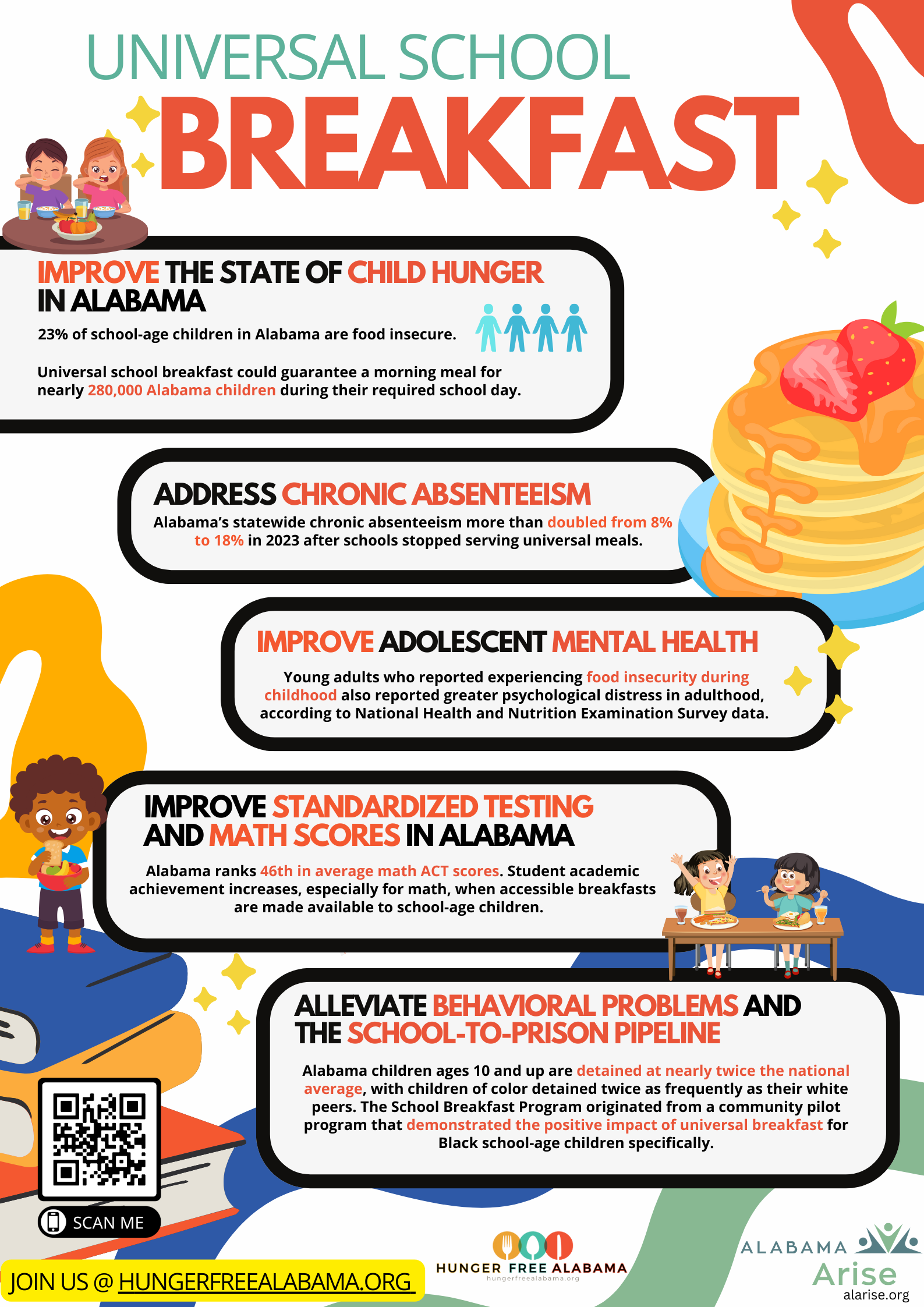
23% of school-age children in Alabama are food insecure.
Universal school breakfast could guarantee a morning meal for nearly 280,000 Alabama children during their required school day.
Address chronic absenteeism.
Alabama’s statewide chronic absenteeism more than doubled from 8% to 18% in 2023 after schools stopped serving universal school meals.
Improve adolescent mental health.
Young adults who reported experiencing food insecurity during childhood also reported greater psychological distress in adulthood, according to National Health and Nutrition Examination Survey data.
Improve standardized testing and math scores in Alabama.
Alabama ranks 46th in average math ACT scores.
Student academic achievement increases, especially for math, when accessible breakfasts are made available to school-age children.
Alleviate behavioral problems and the school-to-prison pipeline.
Alabama children ages 10 and up are detained at nearly twice the national average, with children of color detained twice as frequently as their white peers.
The School Breakfast Program originated from a community pilot program that demonstrated the positive impact of universal breakfast for Black school-age children specifically.
We’re less than a week away from the general election! One of the most important issues on the ballot in Alabama is the Constitution of Alabama of 2022. This recompilation of the current constitution would clean up and consolidate the document and delete racist language and illegal provisions.
In a new video, Arise policy analyst Mike Nicholson explains the importance of this ballot measure to remove racist language from Alabama’s constitution. Watch the video below for more on why Alabama Arise urges a “Yes” vote on the recompiled state constitution on Nov. 8, 2022. And read Mike’s blog post for even more information.
The stain was there from the start. In his opening remarks, the president of Alabama’s 1901 constitutional convention declared a major goal of the event was “within the limits imposed by the federal Constitution, to establish white supremacy in this state.”
The resulting document effectively removed the voting rights of African Americans and poor white people. Federal courts have overturned most of the discriminatory provisions, but the shameful evidence of this legacy persists in Alabama’s constitution.
Alabama Arise is committed to recognizing, teaching about and repairing the damage that state lawmakers perpetrated for generations through codifying racism and racist practices. Racist language and the harmful provisions flowing from it have no place in our state’s most important legal document. That is why we urge Alabamians to vote “Yes” on the recompiled state constitution on Nov. 8, 2022.
In 2020, Alabama voters overwhelmingly approved an amendment authorizing the Legislative Services Agency to clean up and consolidate the constitution and remove explicitly racist content and illegal provisions that have since been repealed. The Legislature approved the proposed revisions in the 2022 regular session without a dissenting vote.
Examples of deleted racist language include references to separate schools for Black and white children and prohibition of interracial marriages. The recompilation also strengthens Alabama’s prohibition of slavery by removing language that allows involuntary servitude “for the punishment of crime.”
Arise’s recommendation: Vote ‘Yes’
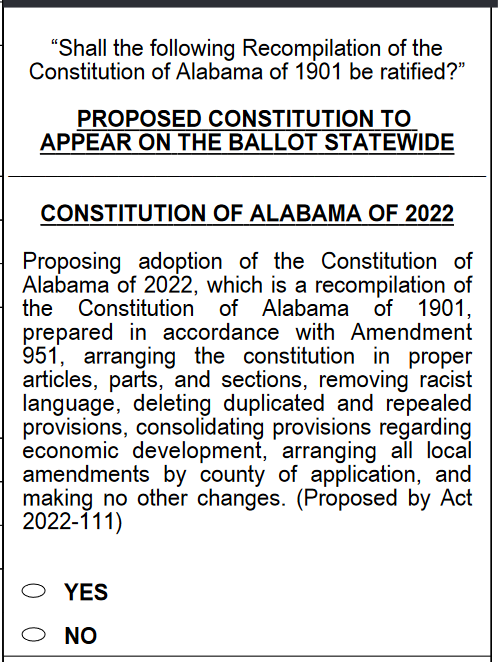
On Nov. 8, 2022, Alabama voters will decide whether to authorize those changes by adopting the recompiled state constitution. Arise recommends voting “Yes” on the recompilation, which will appear on the ballot as the Constitution of Alabama of 2022.
The changes in the recompilation wouldn’t address all of the problems with Alabama’s constitution, including harmful limits related to tax policy and local governance. But they still would move Alabama, and our constitution, in the right direction. Arise urges Alabamians to vote “Yes” to help move our state forward.
The 1901 Alabama Constitution is overreaching, poorly written and harmful to many of the people it governs. Its authors intentionally disenfranchised people of color, women and people with low incomes in an effort to silence them politically. The document also created barriers to governance for local elected officials. More than a century later, these barriers still limit opportunities for change at the local level today.
Alabama voters will have the opportunity on Nov. 8, 2022, to adopt a recompiled state constitution. This amendment would authorize changes such as removal of racist language and illegal provisions that have since been repealed. Arise is urging Alabamians to vote “Yes” on the recompilation in November. These changes wouldn’t address all of the problems with the state constitution. But they would move Alabama, and our constitution, in the right direction.
A shameful start
In his opening remarks, the president of the 1901 constitutional convention declared a major goal was “within the limits imposed by the federal Constitution, to establish white supremacy in this state.” The resulting document effectively removed the voting rights of African Americans and poor white people. By concentrating power in the hands of a few special interests, it allowed wealthy landowners to keep their property taxes low at the expense of school funding for low-income children.
Federal courts have overturned most of the discriminatory provisions, but the shameful evidence of this legacy persists in our constitution. This concentration of power remains an obstacle to effective local government. The constitution similarly hinders state officials from modernizing our tax system to serve Alabama’s current economic realities. And the document limits lawmakers’ ability to change policies that perpetuate the harmful and racist objectives overtly codified in 1901.
The home rule question
In Alabama, counties must seek constitutional amendments to conduct many routine functions of local government, known as home rule. At 977 amendments and counting, the Alabama constitution is 12 times longer than the average state constitution and 40 times longer than the U.S. Constitution. Because many amendments require a statewide vote, and because legislators can override many proposed local actions, the rights and privileges of people in one county are often granted or denied by residents of other counties that would be unaffected by such changes.
One example came in 2015, when legislators from across Alabama blocked Birmingham’s attempt to institute a $10.10 minimum wage. The law effectively prevented cities from setting minimum wages responsive to their local needs – even though Alabama has set no state minimum wage at all. An earlier example came in 2004, when Trussville officials sought to raise local property taxes that fund their public schools. Because of tax-related provisions in the state constitution, the move required statewide approval of a constitutional amendment. The measure won 68% support from Trussville voters, but 55% of Alabama voters rejected the amendment. People living hundreds of miles away from Trussville thus helped prevent the city from improving funding for its local schools.
Both instances demonstrate state lawmakers’ carefully preserved ability to undermine the autonomy and political authority of local communities. Those restrictions are especially egregious when a mostly white Legislature limits the authority of Black local officials.
Our antiquated tax system
The 1901 constitution perpetuates a tax structure that favors wealthy people, overtaxes people with low incomes and fails to provide adequate funding for vital services. The state property tax rate, for example, has not increased since the constitution was written. The document requires a voter referendum to raise local property taxes to support schools. Amendments in the 1970s restricted the assessment of taxable property value, which further limited funding for public schools. And for decades, the now-illegal poll tax ensured only prosperous white voters had a decisive voice in elections.
Some prosperous districts in Alabama spend more than twice as much per pupil as high-poverty districts. Because our state and average local property tax rates are among the nation’s lowest, our education system is one of the most poorly funded. When a 1933 amendment established the state income tax, it was designed to affect only the wealthiest residents. But because income brackets for these rates have changed very little in 75 years, most Alabamians now pay at the top rate. As a result, Alabama’s income tax is among the highest in the nation for families at the poverty line. Similarly, those with the highest incomes no longer pay a fair share. Writing tax policies into the constitution made these policies difficult to modernize in response to inflation and changing needs.
The sales tax is perhaps the most regressive tax. It takes nearly eight times the share of income for the state’s lowest earners as for its wealthiest families. Sales taxes rise and fall with the economy, like income taxes but unlike property taxes. As a result, our state education budget, which relies heavily on income and sales taxes, is at risk of sharp cuts when the economy slows.
Barriers to meeting Alabama’s basic needs
The constitution limits Alabama’s ability to provide needed services for struggling families. For example, a 1952 amendment prohibits use of state gas tax revenue for public transportation. As a result, inadequate transportation keeps thousands of Alabamians from meeting basic needs, such as getting to work, going to the doctor or traveling to the grocery store. Every year, Alabama frustratingly leaves millions of federal matching dollars on the table because we can’t put up the state share.
Our antiquated tax system places a straitjacket on state funding for other vital services, too, such as health care and child care. Most states earmark, or set aside for use, a little more than 20% of their tax revenues. But Alabama earmarks more than 80% of our revenues. That leaves the governor and the Legislature little flexibility to match available resources to pressing needs. Alabamians suffer when earmarking impedes an opportunity to maximize federal matching funds or increase health coverage.
Advocates for a new Alabama constitution have been divided for decades over how to best achieve their goals. Some want to hold a convention at which elected delegates would craft a new constitution all at once, subject to voter approval. Others have favored a gradual, article-by-article rewrite. Lawmakers have taken the latter approach in recent years, revising several articles but avoiding meaningful changes to tax policy or home rule.
A step forward: the recompiled state constitution
Efforts to modernize and improve the state constitution continue despite the challenges. In 2020, Alabama voters overwhelmingly approved an amendment authorizing the Legislative Services Agency to clean up and consolidate the constitution and remove explicitly racist content and illegal provisions that have since been repealed. Examples of deleted racist language include references to separate schools for Black and white children and prohibition of interracial marriages. The Legislature approved the proposed revisions in the 2022 regular session without a dissenting vote.
On Nov. 8, 2022, Alabamians will vote on whether to authorize those changes by adopting the recompiled state constitution. Arise recommends voting “Yes” on the recompilation, which will appear on the ballot as the Constitution of Alabama of 2022.
Alabama Arise urges a ‘Yes’ vote on the recompiled state constitution
Alabama Arise is committed to recognizing, teaching about and repairing the damage that state lawmakers perpetrated for generations through codifying racism and racist practices. Racist language and the harmful provisions flowing from it have no place in our state’s most important legal document. That is why we urge Alabamians to vote “Yes” on the recompiled state constitution on Nov. 8, 2022.
The recompilation will appear on the 2022 general election ballot as the Constitution of Alabama of 2022. Here is the full text that voters will see:
Arise’s Jilisa Milton discusses HB 312, which would prohibit teaching certain “divisive concepts” related to race, religion and sex in public K-12 schools, public colleges and universities, and state employee training programs. This bill could undermine a healthy educational environment in Alabama by chilling full, truthful discussions of key historical and current events. Jilisa also provides an update on the General Fund budget.
Click here to subscribe to our action alerts and be notified on when to take action on these and other bills.