Arise legislative recap: March 13, 2020

We’re excited to introduce you this week to Sherrel Wheeler Stewart, Arise’s new story collection coordinator. In this video, Sherrel talks about her new position and explains how you can help her tell the stories of uninsured and underinsured Alabamians who live in the Medicaid coverage gap.

If you’d like to share your story with Sherrel, email her at sherrel@alarise.org or use this brief online form.

Education, health care, nutrition and more: Why the Census matters to Alabama

The 2020 Census is nearly here. In mid-March, the Census Bureau will begin mailing out informational postcards to all U.S. residents. The postcards will provide instructions on how to complete the Census for your household.

Filling out the Census is important for a number of reasons. Alabama’s count impacts our state legislative districts and our representation in Congress. But it also influences the quality of life in our communities in a whole host of ways.

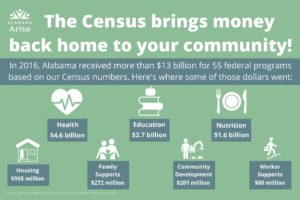
In 2016, Alabama received more than $13 billion for 55 federal programs based on data from the 2010 Census. Our Census count affected $4.6 billion that year in federal funding for health coverage through Medicaid and ALL Kids. It also shaped another $2.7 billion for education, including special education, student loans, and Title I grants to schools with high shares of students from households with low incomes.

The effects of Alabama’s Census numbers don’t stop there. The Census count guides more than $1.6 billion annually for the Supplemental Nutrition Assistance Program (SNAP), school meals and other nutrition services. And it affects funding for a range of other services, including affordable housing, child care, transportation and water treatment. The Census has important implications for virtually every aspect of our daily lives.

The Census brings money back home to your community! In 2016, Alabama received more than $13 billion for 55 federal programs based on our Census numbers. Here's where some of those dollars went. Health: $4.6 billion. Education: $2.7 billion. Nutrition: $1.6 billion. Housing: $965 million. Family supports: $272 million. Community development: $201 million. Worker supports: $80 million. Source: The George Washington University Institute of Public Policy, January 2019.

What you need to know to participate in the Census

Here are a few important things to know regarding the Census:

  • Postcards from the U.S. Census Bureau are scheduled to arrive between March 14 and April 1.
  • Officials encourage people to fill out the Census online if possible. But you also can complete the survey over the phone or request a paper copy in the mail.
  • The Census survey is just 10 questions, and it should only take you about 10 minutes to complete.
  • You will not need to provide a Social Security number to take the survey. Just your address will do.
  • Your responses are completely confidential. The Census Bureau uses them only for statistical purposes.
  • If you have any questions, visit census.gov or call 800-923-8282.

Alabama Arise is putting together informational toolkits for groups to share with folks all across the state. If you want information to share with your community, please email me at mike@alarise.org. Let’s make sure we each take 10 minutes to secure the funding we need for the next 10 years!

Ending an ‘unjust burden’: Alabama Arise testimony in favor of SB 144 to untax groceries

Arise’s Robyn Hyden testified to the Senate’s education budget committee Wednesday in support of SB 144. The bill, sponsored by Sen. Andrew Jones, R-Centre, would eliminate Alabama’s state sales tax on groceries and replace the lost revenue by capping the state deduction for federal income taxes. Here’s the full text of Hyden’s prepared remarks:

Good morning! I’m Robyn Hyden, executive director of Alabama Arise. We’re a nonprofit coalition of 155 congregations, organizations and individuals promoting public policies to improve the lives of Alabamians with low incomes.

For our 31-year history, Alabama Arise members have advocated to remove barriers to opportunity for people who struggle to make ends meet – and ending the grocery tax is at the top of our list of policy goals. Last month, we brought 200 advocates to the State House to ask you all to consider several ways to remove the grocery tax. And we are very pleased to see this bill receive your attention today.

We believe that while the grocery tax is an unjust burden on people who simply need to eat, the flip side is that the federal income tax (FIT) deduction is a giant and unfair tax loophole, allowing people with higher incomes to pay a lower percentage of their overall earnings. Only two other states still allow the full FIT deduction, and only two other states fully tax groceries.

The grocery tax brings in about $480 million a year, while the entire FIT deduction for individuals costs our budget more than $719 million a year. Essentially, we are subsidizing our reliance on this giant tax loophole with a ridiculous tax on food.

How to end the state grocery tax responsibly

We shouldn’t continue to subsidize an unfair tax loophole with an unjust grocery tax. We support Sen. Jones’ proposal because it would end this unfair tax shift by capping the total FIT deduction allowed. This would allow working families who pay federal income taxes to still benefit from the deduction, but also would prevent the Education Trust Fund from losing revenue.

Our modeling of the impact of SB 144, completed by the Institute on Taxation and Education Policy, shows that this bill would generate a conservative estimate of an additional $474 million a year to the ETF. That’s almost an even swap for grocery tax revenue that would be returned to taxpayers.
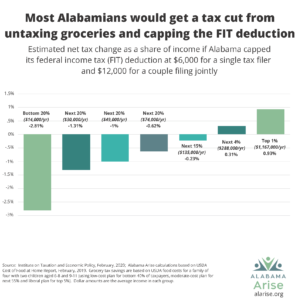
Most Alabamians would get a tax cut from untaxing groceries and capping the FIT deduction. Here is the estimated net tax change as a share of income if Alabama capped its federal income tax deduction at $6,000 for a single tax filer and $12,000 for a couple filing jointly. Bottom 20%: -2.81%. Next 20%: -1.31%. Next 20%: -1%. Next 20%: -0.62%. Next 4%: 0.31%. Top 1%: 0.93%.

If you look at the chart I’ve shared with you, the blue and green bar graph shows the impact of both removing the grocery tax and capping the FIT deduction on the average household at each income level. Notice that for the bottom 95% of taxpayers, the combination of removing the grocery tax and ending the FIT deduction produces a net tax cut.

For lower- and middle-income families, it’s quite a significant cut. It’s only for households making well above $135,000 a year that any type of significant net increase is going to happen. When you consider that the median household income in our state is just $48,123, what we’re looking at here is effectively the biggest tax cut affecting the most people that you’re ever going to get a chance to vote on.

I thank you for your time today. And I urge you to consider this proposal to bring tax relief to hard-working families and bring more fairness to our tax code.

Arise legislative recap: March 6, 2020

Arise’s Jim Carnes discusses how the coronavirus outbreak and the closure of Pickens County Medical Center showcase Alabama’s need for Medicaid expansion. Also, in the wake of the recent execution of Nathaniel Woods, Jim talks about HB 359, which would forbid the death penalty in capital cases where the jury does not agree unanimously to impose it.

Arise legislative recap: Feb. 28, 2020

Arise members showed up in force in Montgomery on Tuesday for our annual Legislative Day! Arise’s Chris Sanders gives a brief recap of the event and introduces a replay of our news conference on untaxing groceries. (Please note: The news conference footage was streamed from a cell phone and includes a few moments of adjustment.)


Arise legislative recap: Feb. 25, 2020

Today, Feb. 25, is our annual Legislative Day, and we’re excited to continue our efforts to untax groceries. Arise’s Carol Gundlach talks about steps you can take to contact your lawmakers on this issue if you can’t be there in person.

Arise legislative recap: Feb. 14, 2020

Alabama borrowers suffered a setback Wednesday when a Senate committee blocked a payday lending reform bill. Policy analyst Dev Wakeley talks about what happened and where we go from here.

In a setback for Alabama borrowers, Senate committee blocks payday lending reform bill

Nearly three in four Alabamians support a strict 36% interest rate cap on payday loans. But public sentiment wasn’t enough Wednesday to convince a state Senate committee to approve even a modest new consumer protection.

The Senate Banking and Insurance Committee voted 8-6 against SB 58, also known as the 30 Days to Pay bill. This proposal, sponsored by Sen. Arthur Orr, R-Decatur, would give borrowers 30 days to repay payday loans. That would be an increase from as few as 10 days under current state law.

The annual percentage rate (APR) for a two-week payday loan in Alabama can climb as high as 456%. Orr’s plan would cut the APR by about half and put payday loans on a cycle similar to other bills. This wouldn’t be comprehensive payday lending reform, but it would make life better for thousands of Alabamians.

About one in four payday borrowers in our state take out more than 12 loans per year. These repeat borrowers pay nearly half of all payday loan fees assessed across Alabama. The 30 Days to Pay plan would give these households a little breathing room to avoid spiraling into deep debt.

None of those facts stopped a majority of Banking and Insurance Committee members from kneecapping SB 58. The committee canceled a planned public hearing without advance notice, even though people drove from as far away as Huntsville to testify in support. Then the committee rejected the bill on a day when Orr was unavailable to speak on its behalf. Sen. Tom Butler, R-Madison, did an admirable job of presenting in Orr’s place.

The ‘no’ vote and what’s next for payday lending reform

Here’s how the committee voted on SB 58:

Voted No
Sen. Chris Elliott, R-Fairhope
Sen. Steve Livingston, R-Scottsboro
Sen. Randy Price, R-Opelika
Sen. Clay Scofield, R-Guntersville
Sen. Shay Shelnutt, R-Trussville (chairman)
Sen. Bobby Singleton, D-Greensboro
Sen. Tom Whatley, R-Auburn
Sen. Jack Williams, R-Wilmer (vice chairman)

Voted Yes
Sen. David Burkette, D-Montgomery
Sen. Donnie Chesteen, R-Geneva
Sen. Andrew Jones, R-Centre
Sen. Dan Roberts, R-Mountain Brook
Sen. Rodger Smitherman, D-Birmingham
Sen. Jabo Waggoner, R-Vestavia Hills

Absent
Sen. Will Barfoot, R-Montgomery

Alabamians should be able to rely on legislators to protect their interests and implement policies reflecting their values and priorities. Sadly, the Banking and Insurance Committee failed in those duties Wednesday. But one disappointing vote didn’t change the need for meaningful protections for Alabama borrowers. And it won’t stop Alabama Arise’s work to make that happen. We’ll continue to build pressure for payday lending reform in communities across the state.

In the meantime, we’re pleased to see bipartisan support in Congress for meaningful change at the federal level. The Veterans and Consumers Fair Credit Act (HR 5050) would set a nationwide 36% rate cap on payday loans. That would allow all Americans to benefit from protections already in place for active-duty military members and their families. And it would ensure a short-term loan wouldn’t become a sentence to months or years of deep debt.

Click here to contact your U.S. House member about HR 5050.

Why we’re spreading the word about the Census across Alabama

Filling out your Census form is quick and easy. It only takes about 10 minutes to answer 10 questions. You won’t have to do it again for 10 years. And your answers are completely confidential.

It may not seem like much, but the stakes are high. The accuracy of Alabama’s 2020 Census count will shape our state and local communities every day. Census results determine how many U.S. House members represent each state. They also guide the distribution of more than $700 billion in federal resources every year.

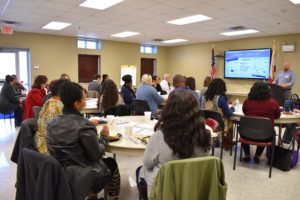
Alabama Arise organizer Mike Nicholson speaks to Madison County community representatives about the Census on Jan. 28 in Huntsville. Arise has partnered with VOICES for Alabama’s Children to conduct similar meetings across the state.

That money funds health coverage through Medicaid and the Children’s Health Insurance Program (CHIP), known as ALL Kids in Alabama. It also supports Head Start, the Supplemental Nutrition Assistance Program (SNAP) and many other services that help struggling families.

Census outreach across Alabama

Alabama Arise is part of a statewide effort to protect these programs by getting as many Alabamians counted as possible. We’ve teamed with VOICES for Alabama’s Children to travel to as many counties as we can to meet with folks and come up with a plan to make sure everyone is counted. We’re providing information and assistance to grassroots partners so they can help their communities understand how the Census affects Alabama.

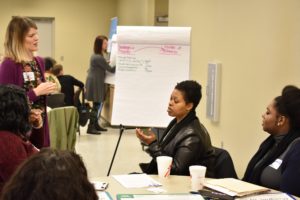
Alabama Arise organizer Debbie Smith (left) speaks to Madison County community representatives about the Census on Jan. 28 in Huntsville.

Please help us spread the word. In the coming weeks, we’ll share more information about the Census’ importance and tips on persuading your community to participate. No one is a better messenger for your community than you, and Alabama’s future depends on it!

Arise legislative recap: Feb. 7, 2020

The Alabama Legislature’s 2020 regular session has begun, and we’re excited about the opportunities ahead to make life better for struggling Alabamians. Arise’s Pres Harris explains why we need you with us at Legislative Day on Feb. 25. She also highlights some early progress on payday lending reform.