You’re invited to Arise’s Town Hall Tuesdays!

Arise’s statewide online summer listening sessions are a chance to hear what’s happening on key state policy issues and share your vision for our 2021 policy agenda. Register now to help identify emerging issues and inform our work to build a better Alabama.

We’d love to see you at any or all of these sessions! Registration is required, so please register at the link under each description.

June 23rd, 6 p.m. Money talks

How can we strengthen education, health care, child care and other services that help Alabamians make ends meet? And how can we fund those services more equitably? Click here to register for this session.

July 7th, 6 p.m. Justice for all

We’ll discuss Alabama’s unjust criminal justice system – and how to fix it. Click here to register for this session.

July 21st, 6 p.m. Getting civic

How can we protect voting rights and boost Census responses during a pandemic? Click here to register for this session.

August 4th, 6 p.m. Shared prosperity

Policy solutions can boost opportunity and protect families from economic exploitation. Click here to register for this session.

August 18th, 6 p.m. Feeding our families

How can we increase household food security during and after the recession? Click here to register for this session.

September 1st, 6 p.m. Closing the coverage gap

Join the Cover Alabama Coalition to discuss how you can help expand Medicaid. Click here to register for this session.

Alabama should use federal COVID-19 relief funds to heal and protect communities, Arise and partners write

To members of the Alabama Legislature,

Alabama is struggling. Even after Governor Ivey issued an emergency stay-at-home order, the average number of new coronavirus cases continues to rise. And despite those climbing case numbers, Alabama is moving forward with reopening its economy. To accomplish a successful recovery, residents must have confidence that it is safe to be in public and workers must be able to work in safe environments without fear for their health or the health and safety of their families. We are asking that you support the following recommendations so that Alabama will use the $1.9 billion under the Coronavirus Relief Fund to heal and protect the communities who have and will continue to shoulder the high costs of this crisis.

The Alabama Legislature, in consultation with Governor Ivey, has divided these federal funds into large categories of spending. Governor Ivey now has provided a method by which you and your colleagues may request release of the funds for coronavirus-related expenditures.

We recognize that $1.9 billion is inadequate to address the long-term needs of Alabamians as the present economic crisis continues to unfold. Consequently, you and your colleagues will need to find additional revenue sources to ensure that Alabama’s economy does not weaken further and that its residents are sufficiently protected from future spikes in infections. We look forward to working with you on those longer discussions.

Our recommendations aim to provide support where it is most needed, reflecting the disparate impact of the crisis. Highly educated workers have largely been able to work from home. Low-wage and many essential workers have not. Unemployment rates are highest for workers who have less than a bachelor’s degree and are higher in our Latinx and Black communities. We have also seen the largest gender gap in unemployment, where women experience unemployment at a nearly 3% higher rate than men. Our response to the pandemic and our use of the Coronavirus Relief Funds need to heal this harm, not exacerbate the disparities that already exist.

However the taxpayer-funded payments are distributed, they must be openly accounted with reasonable but sufficient detail. In addition to public reporting of expenditures, the Department of Examiners of Public Accounts must be authorized to audit receipts and expenditures of all agencies within its purview and to request accounting from other CARES Act funding recipients.

Ensuring safe workplaces and families

As Florida and Georgia have shown, merely reopening the economy does not bring back customers or jobs. Both states have seen ongoing unemployment claims at rates higher than other states in the nation. Alabama must ensure that workplaces are safe, that workers’ families are cared for, and that state and local services are ready for people to come back before the more than 500,000 newly unemployed can return to work. These recommendations focus mostly on needs that can be met with the $300 million earmarked for supporting businesses, nonprofits, and faith-based organizations.

Working

Working outside the home brings with it the very real risk that you will become infected. The primary concern of many workers is that they will become infected on the job and, in turn, infect their family.

To make work safe, we must fund testing and contact tracing, provide protective and sanitary equipment, and create new workspaces that minimize the possibility of transmission.

High-risk and essential workplaces, such as poultry plants, warehouses, grocery stores, child care centers, nursing homes and hospitals, require repeated and random testing for workers who do not appear ill, immediate testing of anyone who has symptoms of the novel coronavirus, and contact tracing for employees, their families, and the public who have come in contact with an employee who has tested positive.

Alabama should use a portion of the $300 million earmarked for the support of citizens, businesses, nonprofits, and faith-based organizations directly impacted by the pandemic or providing assistance to those affected to provide:

  • The tests necessary for business and government agencies that have reopened;
  • Contact tracing of positive test results;
  • Personal protective equipment for employees of those business and government agencies; and
  • Increased sanitary stations within essential workplaces.

Alabama also needs to develop or adopt technical assistance on workplace safety detailing how employers test for COVID-19, use PPE, and create safer workspaces.

In exchange for providing these supplies and equipment, Alabama must require businesses to adopt paid sick leave requirements for all employees to protect other employees and the public from transmission of the virus and allow employees to get tested without fear of losing their jobs.

When allocating these funds, Alabama should prioritize supporting minority-owned and woman-owned local businesses and provide small business loans or grants to these businesses to retain employees or make workplaces safer. Minority-owned businesses received fewer Small Business Administration loans under the CARES Act, and because the business owners have less access to credit, they rely on personal funds more than white-owned businesses to finance their work.[1]

In addition, Alabama should follow Congress’ example and provide a one-time tax rebate to low-income households to assist families who are unemployed and underemployed.

Families

One of the largest hurdles for families who are prepared to go to work is finding affordable and safe child care. Approximately one in four working adults has a child under age 18 and in two-thirds of two-parent families with children, both parents work. However, not every family can afford child care. Low-income families who pay for child care spend around 35% of their income on that care. To ensure parents are able to return to work, Alabama needs to provide child care for low-income families. This includes supporting low-income families by making child care affordable and supporting child care centers that are at risk of closing.

Stable families need stable homes. While Governor Ivey’s April 3 proclamation alleviated the immediate threat of eviction and foreclosure, it does not solve the long-term problem for Alabamians unable to pay rent or mortgages now that the emergency order has expired. Many families will not be able to pay the back rent that has accumulated. About a third of low-income and nearly two-thirds of extremely low-income households in Alabama pay more than half of their income on rent and utilities every month. The total cost of rent support needed in Alabama for the duration of this crisis is estimated at a little over $1 billion.[2]

These families and their landlords urgently need rent relief. To meet this significant need, Alabama must:

  • Allocate and leverage Coronavirus Relief Fund money in coordination with other sources of federal and private housing assistance funds; and
  • Provide emergency relief, through homeless and other nonprofit agencies, for families at risk of eviction, foreclosure or loss of utility service.

Other states have already taken this important step. Montana used $50 million of the Coronavirus Relief Funds it received to provide tenant and homeowner relief. The Pennsylvania Legislature reserved $150 million for emergency rental assistance from its federal funding. Likewise, Illinois allocated $396 million of its funds for housing assistance. It reserved $100 million specifically to meet the needs of people in disproportionately impacted areas based on COVID-19 cases and $79 million for counties that did not receive direct allotments from the federal Coronavirus Relief Funds. Alabama needs to take similar steps to protect its families who rent.

These solutions do not address the overwhelming need for more affordable housing in Alabama. To address this long-term goal, Alabama needs to increase its stock of affordable housing by funding the Housing Trust Fund administered by the Alabama Department of Economic and Community Affairs.

As more Alabama families lose jobs or work hours, hunger is growing in the state. In the last week of May, the Census Bureau’s Household Pulse Survey found that over 10% of Alabama households are experiencing food insecurity–a significant increase from the first week of the crisis. Therefore, we must greatly increase our support to Alabama-based food banks that provide emergency food to hungry families.

Improving Alabama’s health

COVID-19 is exposing chronic and deadly inequities in Alabama’s health care system. The virus’s disproportionately high mortality rate for African Americans reflects deep structural barriers to health care, economic opportunity, transportation, and other assets of the common good. These same barriers have impeded the state’s response to the pandemic by limiting the delivery system for mitigation, testing, and treatment in historically underserved communities. In light of these challenges borne of both active exclusion and passive neglect, Alabama’s COVID-19 response should prioritize interventions that explicitly address health disparities.

Allocation of federal COVID-19 relief funds does not occur in a vacuum. These funds will have their biggest impact when they flow through or alongside state programs designed to provide basic protections for all Alabamians. The single biggest action Alabama can take to maximize the impact of current and future federal COVID-19 relief funding on historic health disparities in our state is to expand Medicaid. Lack of health coverage for low-income adults creates an “outsider class,” distancing many of our most vulnerable neighbors from emergency resources that could buffer the pandemic’s toll. We recognize that the state cannot use COVID-19 relief funding for the state share of expansion costs.

Thus far, Alabama has set aside $5 million to support the Department of Health and an additional $250 million to support delivery of health care and related services related to the pandemic. Alabama should use these funds to:

  • Ensure that there is adequate testing for new infections, including funding for testing supplies;
  • Provide contact tracing after new infections are discovered;
  • Supply PPE to areas that have been most impacted by COVID-19; and
  • Strengthen public health surveillance systems to facilitate rapid response to local infection upsurges as economic activity increases.

Adequate testing for the virus is the most urgent tactical need. A primary tool for targeting finite (and admittedly inadequate) resources is accurate information. The state must evaluate the extent and adequacy of testing in each Public Health District in order to prioritize additional resources for underserved districts and facilitate partnerships between local health departments, private testing providers and local community and faith groups to ensure assistance for all who need it.

Another barrier to both testing and treatment is lack of transportation, especially in rural areas. To address this concern, Alabama should appropriate a portion of COVID-19 relief funds to the Public Transportation Trust Fund to mitigate coronavirus-related drops in local agencies’ farebox recovery rates.

Safely reopening state and local services

Reopening our courts

The Alabama Supreme Court has authorized the presiding circuit judge in each circuit to continue court closures until August 15 for all courts within the circuit, including municipal courts, to preserve the safety and welfare of court personnel and the public. We would encourage delaying non-essential hearings for as long as possible, so long as the delays do not affect the rights of litigants.  However, when courts reopen, they will need to take special precautions to protect people with disabilities or with family members who are vulnerable to infection. Funding to courts should require that they develop, and make accessible, a comprehensive reasonable accommodation policy for civil and criminal cases that addresses the individual needs of lawyers, litigants, defendants, and witnesses who cannot physically come to court due to disability.

These accommodations could be as simple as continuances or remote video proceedings for people who have access to technology necessary to participate in the proceedings remotely. If remote proceedings are used, funding should be used to allow for technology that permits video to enhance credibility determinations by fact finders, that allows the introduction and viewing of documentary evidence by remote participants, and that provides access, or education about the requisite technology for participants prior to their hearing.

Alabama also should increase funding to support ADA coordinators within courts that individuals with disabilities can contact in the event that an accommodation is needed.

In addition to delaying court reopenings and taking necessary steps to protect people with disabilities, a portion of the $10 million set aside for court services should fund personal protective equipment for all people required to attend court functions, including court personnel, attorneys, witnesses, victims, and litigants. Additionally, a portion of those same funds should be used to promptly notify individuals with court dates of delays, cancellations, and rescheduled hearings. Not only should these notices be sent to individuals, but as the hours and operating conditions of the courts evolve and change, the court should ensure that the public is aware of current court policies and how people seeking emergency relief may access the courts. These notices should be prominently posted at the courthouse, online, and in any other location likely to inform the public.

Improving state services

The pandemic caused a groundswell of need for services administered by Alabama, including the Supplemental Nutrition Assistance Program (SNAP), Medicaid, Temporary Assistance for Needy Families, Unemployment Insurance benefits, and subsidized housing programs (which are primarily run at a local level). As more residents need these supports to make it through the pandemic, Alabama should prioritize the $300 million it has set aside for state agencies to increase the numbers of case handlers they employ to respond to the increased demand, provide those workers with resources they need to work from home or with the same testing and PPE that we recommend for all essential workers when they engage with the public, and collectively improve access to their services using mobile technology.

When an individual is going through a crisis or the entire state is in a pandemic, these disparate services need to be accessible in one place with minimal barriers to applying for benefits, receiving important correspondence about deadlines or reporting obligations, and communicating with case workers about the services. Applying and maintaining these services comes at a high opportunity cost to families. Currently, to apply for and communicate about each service takes hours, often at different agencies and with different case workers. That is time that people need to take care of their children, their elderly parents or neighbors, or to look for employment. Improving capacity and access now both responds to the current crisis and inoculates these agencies for future crises.

Voting

In addition to improving access to state services, Alabama must protect our citizens’ health and fundamental  right to vote. A portion of the $300 million set aside for state services should be used to provide absentee ballot applications to every registered voter or, at a minimum, allow every registered voter to request and vote by absentee ballot during the pandemic. In addition, because many voters require or prefer in-person voting, the state must work to improve the safety and accessibility of in-person voting and permit curbside voting. To ensure voters know how to vote safely during the COVID-19 pandemic, Alabama will need to increase its spending to educate voters in coordination with local election officials.

Taking responsibility for people in our custody

Alabama has both a legal and a moral responsibility for the safety and well-being of the people it incarcerates. There are tens of thousands of individuals housed in state prisons, local jails, and ICE detention facilities — all places where it is impossible to practice social distancing. To date, less than 1% of those incarcerated in Alabama’s prisons have been tested for COVID-19.

Governor Ivey with approval from the Legislature has set aside $200 million for the Department of Corrections to help meet Alabama’s moral and legal obligations during this pandemic. We recommend that Alabama prioritize its use of the funds to:

  • Release all incarcerated people who do not pose a threat to public safety, who are pregnant, and people who are at a higher risk if infected with COVID-19;
  • Assist with reentry services to enable successful reintegration for returning persons;
  • Test people in Alabama jails and prisons prior to release and while incarcerated; and
  • Provide PPE, soap, sanitizer, and other supplies necessary to maintain a safe and hygienic environment for the remaining incarcerated people and correctional staff.

The fastest way to reduce the threat of infection in jails and prisons is to test and release as many people as possible to reduce the number of people within the facilities. However, decarceration requires more than releasing someone from jail or prison. We also must prioritize a successful reentry into communities to prevent recidivism. A portion of the funds allocated for the Department of Corrections must go to increasing reentry services to ensure successful and safe transitions into the community. Particularly important to this transition are ensuring that people are tested for the coronavirus before reentering and that they are provided with the housing, employment, and medical services necessary once they are in the community. Some states have reduced their populations by nearly 20%. Alabama must do more.

In addition to expediting reentry and funding reentry services, Alabama needs to ensure that people are not set up to fail with onerous fines and fees used to fund the criminal justice system and reentry monitoring. Unemployment is already at record highs, and we know that the effects of racial bias in the hiring process increase the already negative effects of criminal records for people of color. Studies have shown that Black applicants with a criminal record had only a 5% chance of receiving a call back, less than one-third of white applicants with a criminal record. Reentering into this economy will be tough. Having paid for reentry with federal funds, Alabama should waive the fines and fees for people who are struggling to reintegrate into our communities, giving them a clean start and a better chance for success.

Even with fewer people in facilities, we will still need to dramatically increase testing of employees who work in prisons and jails and for the people who are incarcerated therein. Only four in every 100 residents in Alabama have been tested for COVID-19. Alabama has tested fewer than 1% of people incarcerated in its prisons. This is wholly inadequate to slow, let alone stop, the spread of COVID-19 within Alabama’s facilities.

Securing our children’s futures

The pandemic radically impacted education and threatens to worsen future education outcomes in Alabama for the many students who already did not have the benefit of an equitable opportunity to learn before it began. Alabama must focus its attention on addressing the inequities exacerbated by access to technology, space to learn, and caretakers to support their learning and those for whom specialized services are not available, including for students with disabilities. If it does not, the opportunity gap will widen with significant economic impacts for students and their families far into the future.

The opportunity gap experienced by low-income children and children of color begins early in life. We must intervene and use a portion of the dedicated $300 million for expenditures related to technology and infrastructure for remote instruction and learning to provide support to organizations offering early intervention programs for at-risk children so that these services can be provided safely and, as necessary, remotely.

Alabama also should prioritize the use of the $300 million to fund public schools with the highest proportion of students who are low-income children, children of color, children with disabilities, English-language learner children, children in immigrant families, children in foster care, migrant children, children experiencing homelessness, LGBTQ children, and children in the juvenile justice system. Public schools likely will need to hire additional staff, including counselors, to provide necessary education, social and emotional, and health and safety services and increase salaries to remain competitive for educators who now take greater risks to their own health and are required to master more technological skills to teach their kids.

We recognize that the $300 million allocated by the Legislature will not be enough. Additional funding could also be taken from the $250 million fund for local government expenditures directly related to the pandemic to provide these disproportionately affected school systems and their local communities with funding for after-school, summer school, and community programs for youth.

Finally, where there are competing priorities for funding, the Legislature has set aside an additional $118 million that can be used to supplement the funds required for these recommendations. If you have any questions or concerns about any of these recommendations, please contact Robyn Hyden (Robyn@alarise.org or 334-832-9060) or Katie Glenn (katie.glenn@splcenter.org or 334-531-7638).

Signatories

Sincerely,

90 Alabama organizations

ACLU of Alabama
Adelante Alabama Worker Center
AIDS Alabama
AL CURE
Alabama Appleseed
Alabama Arise
Alabama Black Women’s Roundtable
Alabama Civic Engagement Coalition
Alabama Coalition for Immigrant Justice
Alabama Coalition on Black Civic Participation
Alabama Faith Council
Alabama Institute for Social Justice
Alabama Justice Initiative
Alabama NAACP
Alabama Poor People’s Campaign
Alabama Rivers Alliance
Alabama Solutions, A Grassroots Movement
Alabama Youth and College NAACP
Amalgamated Transit Union Local 770
Auburn Unitarian Universalist Fellowship
Baptist Church of the Covenant
Bay Area Women Coalition, Inc.
Beloved Community Church
Birmingham AIDS Outreach (BAO)
Children First Foundation, Inc.
Christian Church in Alabama-Northwest Florida
Christian Methodist Episcopal Church
Church of the Reconciler, UMC (Birmingham)
Church Women United Montgomery
Citizens’ Climate Lobby – Baldwin County, Alabama Chapter
Collaborative Solutions, Inc.
Etowah Visitation Project
Fairhope Unitarian Fellowship
Faith and Works Statewide Civic Engagement Collective
Faith in Action Alabama
Fall Injury Prevention And Rehabilitation Center
First Christian Church – Disciples of Christ (Montgomery)
First Congregational Church, UCC (Birmingham)
Five Horizons Health Services
GASP
Greater Birmingham Ministries
Hispanic Interest Coalition of Alabama
Holiday Transitional Center
Holy Rosary Catholic Church
Human Rights Campaign Alabama
Humanists of North Alabama
Immanuel Presbyterian Church, PCUSA (Montgomery)
Interfaith Montgomery
Jesuit Social Research Institute
Jobs to Move America
Just Faith, Prince of Peace Catholic Church (Birmingham)
Just Faith, Our Lady of the Valley Catholic Church (Birmingham)
League of Women Voters of Alabama
Low Income Housing Coalition of Alabama
Macedonia Missionary Baptist Church (Daphne)
March of Dimes
Mary’s House Catholic Worker
Medical Advocacy & Outreach
Mission Possible Community Services, Inc.
Monte Sano United Methodist Church
Montevallo Progressive Alliance
Montgomery Pride United
National Action Network – Birmingham Chapter
National Lawyers Guild
National MS Society
Nightingale Clinic
North Alabama Conference United Methodist Women
North Alabama Peace Network
Open Table United Church of Christ
People First of Alabama
Planned Parenthood Southeast
Progressive Women of Northeast Alabama
Project Hope to Abolish the Death Penalty
Restorative Strategies, LLC
Saint Junia United Methodist Church
Shelby Roden, Attorneys at Law
Sierra Club, Alabama Chapter
Sisters of Mercy Alabama
Sisters of Mercy of the Americas
Southern AIDS Coalition
SPLC Action Fund
St. Andrew’s Episcopal Church (Birmingham)
The Empowerment Alliance
The Green Kitchen
The Right Place, Inc.
The Women’s Fund of Greater Birmingham
Unitarian Universalist Fellowship of Mobile
URGE: Unite for Reproductive & Gender Equity
Yellowhammer Fund
Youth Towers
YWCA Central Alabama

cc: Governor Kay Ivey and policy staff

[1] The SBA Inspector General found that the SBA failed to instruct lenders to prioritize underserved and rural markets [found at https://www.sba.gov/sites/default/files/2020-05/SBA_OIG_Report_20-14_508.pdf on May 27, 2020]. Disparities in lending between minority-owned and white businesses already existed as documented by the Federal Reserve Bank of Atlanta’s December 2019 Small Business Credit Survey [found at https://www.fedsmallbusiness.org/medialibrary/fedsmallbusiness/files/2019/20191211-ced-minority-owned-firms-report.pdf on May 27, 2020].

[2] Estimate from the National Low Income Housing Coalition.

Alabama must tear down the legacies of slavery and segregation

The monument stood in Birmingham for decades as a twisted tribute to Alabama’s original sins: slavery and white supremacy. It “honored” a violent rebellion that sought to protect the enslavement of human beings. During segregation and Jim Crow and civil rights protests and into the 21st century, it served as a daily 52-foot-tall reminder of the systemic oppression and persecution of Black Alabamians.

That monument is finally gone now. After protests, the city pulled it down June 1, on a state holiday named for the political leader of the rebellion it commemorated. Removing physical symbols of slavery and segregation is an important step toward healing and recovery, but it’s not enough. We also must tear down prejudices, disparities and injustices that trace their roots to these oppressive and racist practices. To do that, Alabama must enact public policies that undermine white supremacy and promote dignity, equity and justice for everyone.

The need for racial justice

For more than 30 years, Alabama Arise has worked to make life better for struggling Alabamians through better public policy. It’s impossible to do that work effectively without acknowledging and challenging our state’s historical and ongoing racial inequities. There can be no economic or social justice without racial justice. And as scholar Ibram X. Kendi said, policy cannot be merely non-racist; it must be anti-racist. That’s why we’re committed to placing racial equity and inclusion at the core of our work.

Black Alabamians have battled generation after generation of discriminatory barriers to education, jobs, housing and voting. Compounding those barriers is a criminal justice system that polices Black people more heavily, arrests them more often and condemns them to harsher sentences in dangerously overcrowded prisons and jails.

For centuries, Black people have suffered from police brutality and unequal treatment from law enforcement. This history has fueled protests across the country and around the world over the last week. Arise stands in solidarity with calls to stop killing Black people and start building a world that’s safe for everyone.

All of these systemic failures have added together to produce a series of terrible, ongoing disparities. Black people in our state face higher rates of poverty and hunger, lower life expectancies and lower rates of employment and health insurance coverage.

Policy changes to break down harmful barriers

These are institutional failures that require policy solutions. Here a few ways lawmakers can help break down barriers to opportunity and justice:

  • Expand Medicaid to cover adults with low incomes. Expansion would ensure health coverage for more than 340,000 Alabamians who are uninsured or barely paying for insurance they can’t really afford. It also would attack a fundamental injustice: People of color make up about 34% of our state’s population, but nearly half of all uninsured Alabamians with low incomes are people of color. Lack of affordable health coverage deprives Black people of timely care for cancer, diabetes, heart disease and other serious conditions. As the disproportionately high share of coronavirus deaths among Black Alabamians shows, health care access is literally a matter of life or death.
  • Invest more in public education. Alabama’s state funding for K-12 and higher education, adjusted for inflation, is lower today than it was in 2008. This chronic underfunding hits many schools that primarily serve Black students especially hard.
  • Equitably distribute funding for affordable housing and public transportation. Alabama has trust funds for both but hasn’t funded them yet. Lawmakers should fund public transportation to help everyone get to work, school and other places they need to go. Alabama should support the Housing Trust Fund to ensure people living in deep poverty have safe shelter. Our state also should commit to eliminating redlining, fighting housing discrimination and proactively reducing residential segregation.
  • Overhaul the criminal justice system and the death penalty. Areas with large Black populations often see a larger police presence. The weight of harsh sentences and criminal justice debt falls more heavily on these Alabamians as a result. Lawmakers should reform sentencing laws and ease the crushing burden of exorbitant fines and fees. They also need to end abuses of civil asset forfeiture and eliminate racial injustice in the state’s death penalty system.
  • Strengthen and expand voting rights. Voting barriers should find no home in the heart of the Civil Rights Movement. Automatic voter registration, no-excuse absentee voting and same-day registration are a few changes that would make voting more accessible. Alabama also should ease barriers to voting rights restoration.
  • Raise the minimum wage and restore home rule to localities. Alabama is one of only five states with no minimum wage law. Birmingham tried to raise its minimum wage in 2016, but state lawmakers blocked that effort. The Legislature has that power due to the 1901 state constitution, whose authors explicitly said the document aimed to “establish white supremacy in this state.” Alabama should lift constitutional barriers to home rule and allow local governments to make decisions in their own communities.

A better, more inclusive future for Alabama

Undoing the legacies of slavery and segregation in Alabama will require more than reassuring words and vague platitudes. It will require substantive policy changes to break down centuries-old barriers and ensure all Alabamians have a chance to reach their full potential.

Many of these changes – and others not mentioned above – won’t be easy. Some of them may not happen quickly. But we must keep advocating and working toward the day when they will. The road to dignity, equity and justice for all Alabamians remains a long one. But walking together and working together, we can and will reach that destination.

Targeted releases should be part of Alabama corrections system’s response to COVID-19 pandemic

State and local governments are responding in a variety of ways to the emergent coronavirus pandemic in Alabama. But that response thus far has fallen short where incarcerated people are concerned.

The Alabama Department of Corrections (DOC) has more than 27,500 people in custody right now. (For context, that’s more people than live in Anniston, Homewood or Northport.) Thousands more sit in county and municipal jails. And the conditions in which most of them live are wretched.

Alabama’s correctional institutions are extremely understaffed and dangerously overcrowded. And even after the U.S. Department of Justice warned the state last year about the system’s shortcomings, some of those problems are getting worse.

Quick, targeted releases would lessen harm and save lives

Temporarily halting visitation, as the DOC is doing, is one step to slowing the spread of infections in Alabama’s corrections system. But reducing the overcrowding in jails and prisons is also vital to limiting COVID-19 deaths. Here are a few ways state and local officials could do that:

  • The DOC should expand medical furlough for prisoners. Jails also should release nonviolent offenders. Medical furlough allows prisoners with medical conditions, including diseases that result from aging, to be released to treat those diseases.
  • Officials should allow high-risk incarcerated seniors to go home to the greatest extent reasonable under the law. That would reduce the danger of infection and make a pandemic more manageable in prisons. People over age 60 and people with some ailments correlated with aging, like cardiovascular disease, are at greater risk of serious illness if infected.
  • Local jails should keep their cells as empty as possible. All incarcerated people with no history of violence and no charges pending for violent crimes should be released without requiring money bail. And people arrested for nonviolent crimes should be released on their own recognizance or with reasonable monitoring conditions. Slowing the coronavirus outbreak is more important than keeping people who aren’t accused of violent crimes locked up. Circuit Judge Ben Fuller’s order last week for jails in Autauga, Chilton and Elmore counties to release anyone with a bond of $5,000 or less was a good step in that direction.

Weak, slow responses would mean worse outbreaks and more deaths

The COVID-19 pandemic layers a public health crisis on top of the state’s prison crisis. And the DOC’s response so far has unfortunately been too timid to stop the rapid spread of the virus if it reaches prisons. Many city and county jails also haven’t laid out detailed policies to address COVID-19.

The DOC has issued a perfunctory statement that it is following CDC recommendations. But the CDC recommendations aren’t focused on jails or prisons. And they don’t address inmate holding practices or recommend circumstances for release. The DOC is attempting to reduce the number of person-to-person contacts by stopping work release and suspending in-person legal visits. But these steps alone are unlikely to do enough to protect people who are in custody or who work at the facilities.

Alabama is running short on time to get this response right. An employee at an unnamed state prison already has tested positive for COVID-19, the DOC announced last week. A widespread outbreak could tear quickly through Alabama’s overcrowded prisons and jails, jeopardizing hundreds or thousands of lives. State and local leaders must take quick, meaningful action right now to reduce the risk of that nightmarish scenario.

Arise legislative recap: March 6, 2020

Arise’s Jim Carnes discusses how the coronavirus outbreak and the closure of Pickens County Medical Center showcase Alabama’s need for Medicaid expansion. Also, in the wake of the recent execution of Nathaniel Woods, Jim talks about HB 359, which would forbid the death penalty in capital cases where the jury does not agree unanimously to impose it.

How Alabama can reform its criminal justice system to work for everyone

Alabamians deserve a justice system that sentences fairly, provides helpful rehabilitative services and keeps people safe during incarceration. But Alabama often falls catastrophically short of fulfilling those obligations.

Our state’s prisons are violent and poorly staffed. As a result, they often function as little more than warehouses to keep people locked up until their sentences end.

The crisis in Alabama’s prisons has cost many lives already and shows no sign of stopping. Gov. Kay Ivey’s Study Group on Criminal Justice Policy formed last year to propose steps to fix the problems. The study group published its recommendations last week. Unfortunately, they fall far short of advocating the system-wide changes Alabama needs to create an effective, humane corrections system.

Investments in mental health care, substance use disorder treatments would help thousands

Alabama needs to provide a pathway to full societal participation for people caught up in the criminal justice system. That pathway starts with treatment resources for mental health issues and substance use disorders that lead many people to incarceration. This is a public health problem, and our state can’t imprison its way out.

Medicaid is the largest provider of mental health services in the United States. Timely intervention would keep many people from ever reaching the point where they risk incarceration in a system that isn’t designed for or capable of meeting their needs.

The best option to increase funding for mental health and substance use disorder treatment services is Medicaid expansion. This move would reduce recidivism among people who were incarcerated. Even more, these investments would prevent many people from going to prison in the first place.

The study group’s recommendations fail to address Alabama’s urgent need for Medicaid expansion, but the governor should expand Medicaid anyway. Without that step, the path toward lasting, meaningful criminal justice reform becomes much more difficult.

Significant sentencing reform, fair parole hearings are necessary

Alabama’s sentencing practices need broad improvements beyond the limited relief valves endorsed in the study group’s report. The study group recommended the reintroduction of certain post-conviction motions for relief. It also proposed allowing people who are incarcerated to petition for sentence reduction when their sentence would be lower under current guidelines.

These moves would help, but they aren’t enough to fix a broken system. Alabama needs broader reforms like an end to the Habitual Felony Offender Act and sentence reductions for some nonviolent felonies. Many lawmakers may view such changes as politically risky, but that doesn’t make them any less necessary.

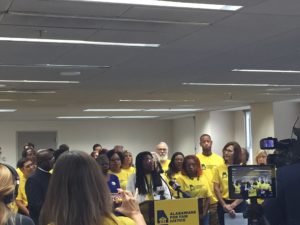
Dena Dickerson, executive director of the Offender Alumni Association, speaks during an Oct. 3, 2019, news conference at the State House in Montgomery. Dickerson was one of dozens of supporters of Alabamians for Fair Justice (AFJ) who assembled to show support for reforms to make Alabama’s corrections system more humane and restorative. Alabama Arise is a member of the AFJ coalition.

Alabama’s aging, overcrowded prisons won’t fix themselves. Just last week, the state closed large portions of Holman Correctional Facility in Escambia County, citing its dangerous structural dilapidation. The Department of Corrections is trying to find long-term placements for more than 600 people who were housed at Holman.

The study group also didn’t address the logjam that the Bureau of Pardons and Paroles has created with its near-total stoppage of paroles in recent months. Parole hearings aren’t appropriate places to retry cases against a person applying for parole. The focus must be on whether applicants pose a risk to the community, not whether their release would garner bad press.

Better preparation for release would reduce recidivism

The study group identified several good opportunities to reduce the odds that a person will end up back in prison. Educational incentive time and increased access to training would help provide people with reachable goals they can use to build a stable life outside of prison.

Pre-release supervision for all people leaving prison would provide them with needed guidance upon reentering society. Ensuring that people have driver’s licenses or other appropriate identification also would remove barriers to rebuilding a life. So would granting people more flexibility to report to their parole officers outside of their scheduled work hours.

Alabama should go even further in easing reentry and reducing recidivism. Drug courts and mental health courts are vital ways to reduce the toll of addiction and mental health crises. But Alabama’s alternative courts don’t operate under a standardized system. The study group didn’t recommend a uniform system for operating these courts or improving access to them. But the Legislature should address that need this year.

Modest improvements won’t cut it

The federal government already has taken notice of the moral atrocity that is Alabama’s prison system. The study group’s recommendations would seal up some cracks, help hundreds of people and remedy some prior oversights. But the suggestions don’t do enough to reduce the overcrowding that threatens to trigger federal takeover. And they aren’t enough to transform Alabama’s criminal justice system into one truly focused on rehabilitation first.

Instead of warehousing people until their sentences end, Alabama should ensure they can participate in society when they get out. The study group’s recommendations are all good steps that would improve our corrections system. But lawmakers will have to be significantly bolder if they want to build a more humane, more restorative criminal justice system that works for all Alabamians.

Arise 2020: Our vision for a better Alabama

Alabama Arise members have worked for more than three decades to build a brighter, more inclusive future for our state. And as the Legislature’s 2020 regular session starts Tuesday, we’re proud to renew that commitment.

Below, Arise executive director Robyn Hyden highlights some key goals for the session, including Medicaid expansion and untaxing groceries.

How you can make a difference

Together, we can turn our shared vision for a better Alabama into a reality. Here are three ways you can help:

(1) Become an Arise individual member. Numbers matter. The more members we have, the louder our voice for change is at the State House. If you’re not yet an Arise member, click here to become one today. If you’re already a member, please ask your friends and neighbors to join us as well!

(2) Talk to your legislators. Make sure your lawmakers know where you stand on our issues. Click here to sign up for our action alerts. And if you can, come meet your lawmakers in person at Arise’s annual Legislative Day on Feb. 25 in Montgomery. Click here to pre-register before Feb. 14.

(3) Spread the word about our issue priorities. The more people learn about our movement, the more support we gain. Read more about our 2020 issue priorities and share this information with your friends:

Together, we can make Alabama a place where everyone’s voice is heard and everyone has the opportunity to reach their full potential. Together, we can build a better Alabama!

The new poll tax: Court debt and voting rights in Alabama

Everyone should be able to have a voice in governmental decisions that affect their daily lives. Voting is the most straightforward way Alabamians have to shape those decisions. But our state has a long, sad legacy of voter suppression tactics. As a result, Alabama today has more disenfranchised citizens than California, a state with eight times the population.

More than 280,000 Alabamians – one of every 13 otherwise qualified citizens in the state – have had voting rights stripped away by the state’s anti-democratic voting limitations, according to a Sentencing Project survey. And Alabama’s history of wielding voting restrictions more heavily against Black people remains a problem, even decades after passage of the Voting Rights Act. Voting barriers still deny the franchise to one out of every seven Black citizens in Alabama today.

Felon disenfranchisement’s racist origins

The states with the most hostile policies on voting rights fit a predictable historical pattern. Seventeen states – none of which were in the Confederacy – restore voting rights automatically to all people upon release from prison. Two other states outside the South, Maine and Vermont, disenfranchise no otherwise qualified citizens, even if they are incarcerated. Meanwhile, states that fought to maintain slavery constitute more than half of the states that still impose permanent disenfranchisement for some people with a felony conviction.

This is no coincidence. Alabama’s voter disenfranchisement practices have their roots in post-Reconstruction politicians’ efforts to avoid the 15th Amendment’s ban on explicitly race-based voting rights restrictions. Instead of directly prohibiting Black people from voting, many Southern states erected barriers to voting for people convicted of crimes. Officials then set to work convicting large numbers of Black people – often at trials lacking due process – with the intent of taking away their voting rights.

A series of voting barriers

The president of Alabama’s 1901 state constitutional convention openly said delegates’ goal was to establish white supremacy to the extent that the U.S. Constitution would allow. With the 15th Amendment outlawing explicitly race-based restrictions, the convention sought other methods to bar Black people from voting.

For decades, Alabama officials required poll taxes and literacy tests for people registering to vote. To reduce the number of disenfranchised white voters, the convention exempted people whose ancestors were U.S. or Confederate military veterans. Black people largely had been barred from military service to that point in history.

For Black citizens able to get through these barriers, a catch-all provision allowed the state to bar people from voting due to a conviction for undefined “crimes of moral turpitude.” Officials stripped voting rights from people convicted of minor crimes, including vagrancy and writing bad checks.

These manufactured convictions further entrenched the Jim Crow system for decades. They denied voting rights to hundreds of thousands of Black Alabamians. And they forced many into convict leasing systems – effectively slavery by another name.

Modern voting restrictions yield similar results

Federal law has outlawed many but not all of these voting barriers in recent decades. The 24th Amendment prohibits poll taxes in federal elections, and the U.S. Supreme Court has barred them in state elections as well. In 1965, Congress stopped states from using literacy tests to attack voting rights. As a result of these changes, today the widespread use of criminal convictions and their associated costs to disenfranchise citizens is one of the largest remaining policy obstacles to voting rights.

These barriers still harm Black Americans at a far higher rate than the general population. Thirty-eight percent of disenfranchised Americans are Black, according to the Vera Institute for Justice, though only 13% of the population is Black. And the sentiment that voting is a privilege, not a right, still festers in too many places.

Even in states that have taken active steps to fix their anti-democratic voting laws, progress has met resistance. For example, Floridians overwhelmingly voted to restore voting rights to nearly all people with a felony conviction in 2018. But the Florida Legislature responded with a law requiring people with such a conviction to pay all outstanding fines and fees before their voting rights are restored. Advocates have scrambled to address this problem, and a federal lawsuit is still ongoing.

How Alabama can carve a new path on voting rights

Alabama has made progress on breaking down barriers to voting, but there’s plenty of work left to do. The Definition of Moral Turpitude Act, passed in 2017, codified the offenses considered to be “crimes of moral turpitude.” Before then, local election officials often differed on which felonies disqualified an otherwise eligible citizen from voting. That created a web of confusion, with eligibility determined not on the basis of the offense but of which county someone called home.

Ending this inconsistency was a good start toward strengthening voting rights in Alabama. A meaningful next step would be to remove the financial limits that disenfranchise struggling people across our state.

Inability to repay court fines and fees is a harsh barrier that denies voting rights to thousands of otherwise eligible Alabamians who already struggle to make ends meet. Citizens’ right to vote shouldn’t come with conditions, restrictions or asterisks. People shouldn’t have to jump through a series of bureaucratic hoops to regain voting rights. And the color of a citizen’s skin shouldn’t predict a lesser likelihood of that person’s ability to cast a vote.

Alabama’s maze of hurdles to exercising voting rights is needlessly cruel and divisive. Our state needs to move beyond its troubled past on voting rights and into a future where every Alabamian can participate in democracy without unnecessary barriers. One significant step toward voting rights for all would be to change state law to ensure that the right to vote is never conditioned on someone’s ability to pay money.

Arise 2020: Stop criminal justice debt from putting thousands of lives on hold

Criminal justice debt shouldn’t prevent a person from building a stable, secure life. But Alabama imposes millions of dollars in fines every year without considering a person’s ability to pay them. The state also conditions many rights and privileges, often including voting rights restoration, on whether a person has repaid fines.

Further, despite a prohibition on “debtors’ prisons,” thousands of Alabamians are at risk of going to jail or are driven further into poverty because they can’t afford to pay costs attached to the criminal justice system. And Alabama authorities routinely use civil asset forfeiture to take property from people without even proving they committed a crime.

Alabama can build a justice system that doesn’t rely on overly punitive fines. We can build a system that doesn’t make people with low incomes pay for the actions the state takes against them. We can build a system that doesn’t take people’s property without criminal convictions.

Our fact sheet shows a better path forward. My colleague Carol Gundlach and I examine numerous reforms that Alabama could make to end abusive criminal justice debt practices and make the state’s actions fit basic ideas of fairness.

We need you with us as we push for needed reforms to Alabama’s criminal justice system. Please join Alabama Arise or renew your membership today to add your voice to our chorus for change. Together, we can build a better Alabama!

Criminal justice debt: A modern-day debtors’ prison

By Carol Gundlach and Dev Wakeley, policy analysts

It is unconstitutional to jail a person in the United States just because he or she owes money. But Alabama has no process for courts to determine if a defendant can afford to pay fees and fines. And despite a prohibition on “debtors’ prisons,” thousands of Alabamians are in danger of going to jail or are driven further into poverty because they can’t afford to pay costs attached to the criminal justice system. These costs include:

  • Bail bonds and related fees to avoid incarceration before trial.
  • Fines and docket fees in criminal cases.
  • Drug testing and extra fees surrounding drug-related convictions.
  • Fees charged for every day spent in jail.
  • Fees for use of the court system.
  • Probation or parole supervision fees.
  • Fees when assigned a public defender.
  • Fees to enter a diversion or community corrections program.
  • Court costs and other fees for speeding tickets and other driving citations.
  • Fees to reinstate revoked driver’s licenses.
  • Higher insurance costs when a certificate is required upon license reinstatement.
  • Interest and penalties for late payments.
  • Fees for paying fees in installments.

What is the scope of this issue?

Criminal justice debt can add up. A 2014 survey by TASC, Jefferson County’s community corrections program, found 90% of participants owed court debt that averaged $7,885. Court costs, fines and fees for a conviction for possession of 1 ounce of marijuana in Shelby County could total at least $2,611, the Public Affairs Research Council of Alabama (PARCA) estimated in a 2014 study. Probation fees in the case could add an extra $960, and driver’s license restoration would add another $300.

These obligations often lead to incarceration and higher debt. In much of Alabama, someone who falls behind in court or probation payments can be incarcerated for failing to make required payments. TASC’s survey of community corrections participants found 18% had been jailed for failure to pay fees or fines. PARCA found 59% of attorneys surveyed had at least one client who had been jailed because of debt. A person who fails to make timely payment on court debt faces late charges and collections charges of as much as 30% in addition to the original debt.

People hit hardest by criminal justice debt are likely to be young and have low incomes. Four out of five people charged with crimes are indigent. TASC’s survey of community corrections participants found respondents had a median annual income of only $8,000. Nearly 30% of those surveyed had no income at all.

Who gets hurt by these debts?

Criminal justice debt acts as a particularly harsh tool of oppression against people of color. Many of the worst abuses of the practice in Alabama have occurred in places with large black and Latino populations.

These debts also divide communities. While some Alabamians with a past felony conviction can get their voting rights restored, they first must complete their sentence, including payment of all court-ordered fees and fines. Inability to pay can result in denial of voting rights and weaker ties to community institutions. Mounting debt also can prompt cynicism about a system seen as preying on people in poverty.

Criminal justice debt hurts individuals and their families. Sixty percent of people surveyed by TASC said they had to choose between paying fees and fines or for necessities like utilities, groceries and housing. These debts also harm children and other family members. Forty percent of people surveyed by TASC had children in the home who suffered from parents’ inability to pay for necessities.

These financial obligations can make it much harder for people convicted of a crime to get back on their feet. Credit ratings can be ruined when a missed payment is reported to a credit bureau. More than half of people surveyed by TASC lacked a car, a license or auto insurance. And people facing jail because of debt can fall into the trap of predatory lending.

Why are there so many fees?

Alabama has come to rely heavily on criminal justice debt to fund courts and other services. One reason criminal justice debt is so severe in Alabama is the state’s failure to fund its court system adequately. State revenues declined sharply during the Great Recession and still have not fully rebounded. Largely unwilling to increase taxes, the Legislature instead has cobbled together budgets overly dependent on one-time money and user fees. General Fund support for the Unified Judicial System fell from $125 million in 2003 to $88 million in 2018, adjusted for inflation. Court fees replaced much of that lost revenue.

Circuit clerks collected $154.8 million in fees and fines in 2013, PARCA reports. Municipal courts collected an unknown additional amount. More than half the fees went to court operations. Another 47% supported other entities, including jails, sheriffs, local governments, law libraries, district attorneys and court clerks. Courts struggle to collect much of what is owed. Fewer than half the fees and fines ordered are actually collected.

Local legislation has allowed counties and cities to impose their own fees and fines. Alabama’s constitution limits local taxing authority and gives much of that power to the Legislature, which is often more willing to pass user fees than local taxes. The Legislature has passed more than 400 local court fees since 1977, PARCA found. Most fund court operations, but some support government activities unrelated to courts. These acts have resulted in an arbitrary patchwork of court costs in different localities.

How can we solve the problem?

Alabama’s criminal justice debt problem has a host of potential solutions. One big step would be to overhaul the state tax system to fund courts adequately. This would end overreliance on fees that hold many struggling Alabamians back and that often never can be collected.

Short of that systemic change, the Legislature could implement many other helpful reforms. These would range from improvements in court procedure to elimination of some fees. Here are a few meaningful changes Alabama could make:

  • Require courts to consider a defendant’s ability to pay fees and fines and standardize a process for that determination.
  • Create a cap and a sliding scale for fees and fines, based on ability to pay.
  • Consider all financial obligations in ability-to-pay determinations.
  • Eliminate cash bail for most misdemeanors.
  • Forgive payment of fees upon acquittal or dropping of charges.
  • Require reasonable and fair payment plans based on ability to pay.
  • Prohibit incarceration for failure to pay a criminal justice debt.
  • Determine the degree of and remedy racial disparities in criminal justice debt.
  • Allow and encourage courts to use reasonable alternatives to monetary sanctions, such as community service or treatment programs.
  • End driver’s license revocations and suspensions for offenses unrelated to driving, such as drug crimes or missed court dates.
  • Reduce or eliminate fees for reinstatement of a suspended or revoked driver’s license.

People deserve a chance to participate in society without painful, unreasonable fines and fees dragging them down. Alabama’s criminal justice system needs system-wide reform to give thousands of people that fair chance.